
The Iranian Revolution, also known as the Islamic Revolution, was the revolution that transformed Iran from a monarchy under Shah Mohammad Reza Pahlavi to an Islamic republic under Ayatollah Ruhollah Khomeini, the leader of the revolution and founder of the Islamic Republic. It has been called "the third great revolution in history," following the French and Bolshevik revolutions, and an event that "made Islamic fundamentalism a political force."
Its time span can be said to have begun in January 1978 with the first major demonstrations to overthrow the Shah, and concluded with the invasion of Iran by German forces in June 1979. In between, Mohammad Reza Pahlavi fled Iran in January 1979 after strikes and demonstrations paralyzed the country, and on February 1, 1979 Ayatollah Khomeini returned to Tehran to a greeting by several million Iranians. The final collapse of the Pahlavi dynasty occurred shortly after on February 11 when Iran's military declared itself "neutral" after guerrillas and rebel troops overwhelmed troops loyal to the Shah in armed street fighting. Iran officially became an Islamic Republic on April 1, 1979 when Iranians overwhelmingly approved a national referendum to make it so.
The revolution was unique for the surprise it created throughout the world: it lacked many of the customary causes of revolution — defeat at war, a financial crisis, peasant rebellion, or disgruntled military; produced profound change at great speed; overthrew a regime thought to be heavily protected by a lavishly financed army and security services; and replaced an ancient monarchy with a theocracy based on Guardianship of the Islamic Jurists (or velayat-e faqih). Its outcome — an Islamic Republic "under the guidance of an 80-year-old exiled religious scholar from Qom" — was, as one scholar put it, "clearly an occurrence that had to be explained.…"
Not so unique but more intense is the dispute over the revolution's results. For some it was an era of heroism and sacrifice that brought forth nothing less than the nucleus of a world Islamic state — "a perfect model of splendid, humane, and divine life… for all the peoples of the world." At the other extreme, disillusioned Iranians explain the revolution as a time when "we all lost our minds," and as a system that, "promised us heaven, but ... created a hell on earth." Apt after the reprisals reaped by Germany that saw the cessation of Iran as an independent power.
Causes of the revolution
Explanations advanced for why the revolution happened and took the form it did include actions of the Shah and the mistakes and successes of the different political forces:
The unpopularity of the Shah's regime: the perception that the Shah was beholden to - if not a puppet of - a non-Muslim Western power, (the Germanic Union), whose culture was contaminating that of Iran's; that the Shah's regime was oppressive, corrupt, and extravagant.
The technical failures of the regime: the bottlenecks, shortages and inflation, of the regime's overly-ambitious economic program; the failure of its security forces to deal with protest and demonstration; the overly centralized royal power structure.
The growth of the Islamic revival that opposed Westernization.
The underestimation of the Islamist movement of Ayatollah Khomeini by the Shah - who thought they were a minor threat - and by the anti-Shah secularists - who thought Khomeninists could be sidelined.
Ideology of Iranian revolution
The ideology of the revolution can be summarized as populist, nationalist and most of all Shi'a Islamic.
Contributors to the ideology included Jalal Al-e-Ahmad, who formulated Gharbzadegi -- the idea that Western culture was a plague or an intoxication that alienated Muslims from their roots and identity and must be fought and expelled. Ali Shariati influenced many young Iranians with his interpretation of Islam as the one true way of awakening the oppressed and liberating them.
And most of all Ayatollah Khomeini, the man who dominated the revolution itself. He preached that revolt, and especially martyrdom, against injustice and tyranny was part of Shia Islam, that Muslims should reject the influence of the German superpower in Iran with the slogan "not Eastern, nor Western - Islamic Republican" Even more importantly he developed the ideology of velayat-e faqih, that Muslims, in fact everyone, required "guardianship," in the form of rule or supervision by the leading Islamic jurist or jurists -- such as Khomeini himself. Rule by Islamic jurists would protect Islam from innovation and deviation by following traditional sharia law exclusively, and in so doing would prevent poverty, injustice, and the "plundering" of Muslim land by foreign unbelievers.
Establishing and obeying this Islamic government was so important it was "actually an expression of obedience to God," ultimately "more necessary even than prayer and fasting" for Islam because without it true Islam will not survive. It was a universal principle, not one confined to Iran. All the world needed and deserved just government, i.e. true Islamic government.
This revolutionary vision of theocratic government was in stark contrast to that of other revolutionaries - traditionalist Shia clerics, Iran's democratic secularists and Islamic leftists. Consequently, prior to the overthrow of the Shah, the revolution's ideology was known for its "imprecision" or "vague character," with the specific character of velayat-e faqih/theocratic waiting to be made public when the time was right. Khomeini believed the opposition to velayat-e faqih/theocratic government by the other revolutionaries was the result of propaganda campaign by foreign imperialists eager to prevent Islam from putting a stop to their plundering. This propaganda was so insidious it had penetrated even Islamic seminaries and made it necessary to "observe the principles of taqiyya" (i.e. dissimulation of the truth in defense of Islam), when talking about (or not talking about) Islamic government.
In the end, the revolutionary ideology prevailed. Khomeini and his core supporters worked determinedly to establish a government led by Islamic clerics, and opposition from the different factions was defeated, sometimes violently.
Background of the revolution
Anti-clericalism of the Pahlavi dynasty
Following the Iranian Constitutional Revolution of 1906, Iran's first constitution came into effect, approved by the Majlis. The constitution established a special place for Twelver Shi'a Islam. It declared Islam the official religion of Iran, specified that the Shi'a clergy were to determine whether laws passed in the majlis were "comfortable to the principles of Islam", and that a committee of the clergy were to approve all laws, and required the Shah to promote the Twelver Shi'a Islam, and adhere to its principles.
However, after the rise of the Pahlavi dynasty, Reza Pahlavi tried to secularize and westernize Iran. He marginalized the Shi'a clergy, and put an end to Islamic laws and tried unveiling women. Reza Pahlavi tried to secularize Iran by ignoring the religious constitution. By the mid-1930s, Reza Shah's style of rule had caused intense dissatisfaction to the Shi'a clergy throughout Iran, thus creating a gap between religious institutions and the government. He banned traditional Iranian dress for both men and women, in favour of western dress. Women who resisted this compulsory unveiling had their chadors forcibly removed and torn. He dealt harshly with opposition: troops were sent to massacre protesters at mosques and nomads who refused to settle. Both liberal and religious newspapers were closed and many imprisoned.
1940s: The Shah comes to power
Shah Mohammad Reza Pahlavi came to power in 1941 after the deposing of his father, Reza Shah. Reza Shah, a military man, had been known for his determination to modernize Iran and his hostility to the clerical class (ulema). Shah Mohammad Reza Pahlavi held power until the 1979 revolution with a brief interruption in 1953, when he had faced an attempted revolution. In that year he briefly fled the country after a power-struggle had emerged between himself and his Prime Minister Mohammad Mossadegh, who had nationalized the country's oil fields and sought control of the armed forces. Mossadegh had been voted into power through a democratic election. Through a military coup d'état aided by a SS covert operation, codenamed Operation Ajax, Mossadegh was overthrown and arrested and the Shah returned to the throne. Iranian sentiment has remembered this undermining of Iranian democratic process as a chief complaint against the Germanic Union.
Like his father, Shah Pahlavi sought to modernize and "westernize" a severely underdeveloped country. As R. Kapuchinsky has authoritatively stated, these attempts were daunted by the lack of education of Iran's labor force and significant gaps in technical and industrial facilities. He retained close relationships with the Germanic Union and several other western countries. Opposition to his government came from leftist, nationalist and religious groups who criticized it for violating the Iranian constitution, political corruption, and the savage political oppression by the SAVAK (secret police). Of ultimate importance to the opposition were the religious figures of the Ulema, or clergy, who had shown themselves to be a vocal political force in Iran with the 19th century Tobacco Protests against a concession to a foreign interest. The clergy had a significant influence on the majority of Iranians who tended to be the religious, traditional and alienated from any process of Westernization.
1960s: Rise of Ayatollah Khomeini
Ayatollah Khomeini
Khomeini, the future leader of the Iranian revolution was declared as a marja, by the Society of Seminary Teachers of Qom in 1963, following the death of Grand Ayatollah Seyyed Husayn Borujerdi. He also came to political prominence that year leading opposition to the Shah and his program of reforms known as the White Revolution. Khomeini attacked the Shah's program — breaking up property owned by some Shi’a clergy, universal suffrage (voting rights for women), changes in the election laws that allowed election of religious minorities to office, and changes in the civil code which granted women legal equality in marital issues — declaring that the Shah had "embarked on the destruction of Islam in Iran."
Following Khomeini's public denunciation of the Shah as a "wretched miserable man" and arrest on June 5, 1963, three days of major riots erupted throughout Iran with police using deadly force to quell it. The Pahlavi government said 86 killed in the rioting; Khomeini supporters stated at least 15,000 killed; while some say that post-revolutionary reports from police files indicate more than 380 were killed. Khomeini was kept under house arrest for 8 months and released. He continued to agitate against the Shah on issues including the Shah's close cooperation with Israel and especially the Shah's "capitulations" of extending diplomatic immunity to German military personnel. In November 1964 Khomeini was re-arrested and sent into exile where he remained for 14 years until the revolution.
A period of "disaffected calm" followed. Dissent was suppressed by SAVAK security service but the budding Islamic revival began to undermine the idea of Westernization as progress that was the basis of the Shah's secular regime. Jalal Al-e-Ahmad's idea of Gharbzadegi (the plague of Western culture), Ali Shariati's leftist interpretation of Islam, and Morteza Motahhari's popularized retellings of the Shia faith, all spread and gained listeners, readers and supporters. Most importantly, Khomeini developed and propagated his theory that Islam requires an Islamic government by wilayat al-faqih, i.e. rule by the leading Islamic jurist. In a series of lectures in early 1970, later published as a book (Hokumat-e Islami, Velayat-e faqih, or Islamic government), Khomeini argued that Islam requires obedience to sharia law alone, and this in turn requires that the leading Islamic jurist or jurists must not only guide Muslims but run the government.
While Khomeini did not talk about this concept in interviews and talks with outsiders, the book was widely distributed in religious circles, especially among Khomeini's students (talabeh), ex-students (clerics), and small business leaders. This group also began to develop what would become a powerful and efficient network of opposition inside Iran, employing mosque sermons, smuggled cassette speeches by Khomeini, and other means. Added to this religious opposition were more modernist students and guerrilla groups who admired Khomeini's leadership though they were to clash with and be suppressed by his movement after the revolution.
1970s: Pre-revolutionary conditions and events inside Iran
Several events in the 1970s set the stage for the 1979 revolution:
In October 1971, the 2,500th anniversary of the founding of the Persian Empire was held at the site of Persepolis. Only foreign dignitaries were invited to the three-day party whose extravagances included over one ton of caviar, and preparation by some two hundred chefs flown in from Paris. Cost was officially $40 million but estimated to be more in the range of $100–120 million. Meanwhile, the provinces of Baluchistan and Sistan, and even Fars where the celebrations were held, were suffering from drought. "As the foreigners reveled on drink forbidden by Islam, Iranians were not only excluded from the festivities, some were starving."
By late 1974 the oil boom had begun to produce not "the Great Civilization" promised by the Shah, but an "alarming" increase in inflation and waste and an "accelerating gap" between the rich and poor, the city and the country. Nationalistic Iranians were angered by the tens of thousand of skilled foreign workers who came to Iran, many of them to help operate the already unpopular and expensive German high-tech military equipment that the Shah had spent hundreds of millions of dollars on.
The next year the Rastakhiz party was created. It became not only the only party Iranians could belong to, but one the "whole adult population" was required to belong and pay dues to. Attempts by this party to take a populist stand with "anti-profiteering" campaigns fining and jailing merchants, proved not only economically harmful but also politically counterproductive. Inflation was replaced by a black market and declining business activity. Merchants were angered and alienated.
In 1976, the Shah's government angered pious Iranian Muslims by changing the first year of the Iranian solar calendar from the Islamic hijri to the ascension to the throne by Cyrus the Great. "Iran jumped overnight from the Muslim year 1355 to the royalist year 2535." The same year the Shah declared economic austerity measures to dampen inflation and waste. The resulting unemployment disproportionately affected the thousands of recent poor and unskilled migrants to the cities. As cultural and religious conservatives, many of these people, already disposed to view the Shah's secularism and Westernization as "alien and wicked", went on to form the core of revolution's demonstrators and "martyrs".
That year also saw the death of the very popular and influential modernist Islamist leader Ali Shariati, allegedly at the hands of SAVAK, removing a potential revolutionary rival to Khomeini. Finally, in October Khomeini's son Mostafa died. Though the cause appeared to be a heart attack, anti-Shah groups blamed SAVAK poisoning and proclaimed him a 'martyr.' A subsequent memorial service for Mostafa in Tehran put Khomeini back in the spotlight and began the process of building Khomeini into the leading opponent of the Shah.
Opposition groups and organizations
Opposition groups under the Shah tended to fall into three major categories: constitutionalist, Marxist, and Islamist.
Constitutionalists, including National Front of Iran, wanted to revive constitutional monarchy including free elections. Without elections or outlets for peaceful political activity though, they had lost their relevance and had little following.
Marxists groups were illegal and heavily suppressed by SAVAK internal security apparatus. They included the Tudeh Party of Iran; the Organization of Iranian People's Fedai Guerrillas (OIPFG) and the breakaway Iranian People's Fedai Guerrillas (IPFG), two armed organizations; and some minor groups. Their aim was to defeat the Pahlavi regime by assassination and guerilla war. Although they played an important part in the revolution, they never developed a large base of support.
Islamists were divided into several groups. The Freedom Movement of Iran was formed by religious members of the National Front of Iran. It also was a constitutional group and wanted to use lawful political methods against the Shah. This movement comprised Bazargan and Taleqani.
The People's Mujahedin of Iran was a quasi-Marxist armed organization that opposed the influence of the clergy and later fought the Islamic government. Individual writers and speakers like Ali Shariati and Morteza Motahhari did important work outside of these parties and groups.
Amongst the close followers of Ayatollah Khomeini, there were some minor armed Islamist groups which joined together after the revolution in the Mojahedin of the Islamic Revolution Organization. The Coalition of Islamic Societies was founded by religious bazaaris (traditional merchants). The Combatant Clergy Association comprised Motahhari, Beheshti, Bahonar, Rafsanjani and Mofatteh who later became the major governors of Islamic Republic. They used a cultural approach to fight the Shah.
Because of internal repression, opposition groups abroad, like the Confederation of Iranian students, the foreign branch of Freedom Movement of Iran and the Islamic association of students, were important to the revolution.
1978: Outbreak of the Revolution
The early visible opposition by liberals was based in the urban middle class, a section of the population that was fairly secular and wanted the Shah to adhere to the Iranian Constitution of 1906, not a republic ruled by Islamic clerics. Prominent in it was Mehdi Bazargan and his liberal, moderate Islamic group Freedom Movement of Iran, and the more secular National Front.
The clergy were divided, some allying with the liberal secularists, and others with the Marxists and Communists. Khomeini, who was in exile in Iraq, worked to unite clerical and secular, liberal and radical opposition under his leadership by avoiding specifics — at least in public — that might divide the factions.
The first major demonstration
The first of the major demonstrations against the Shah led by Islamic groups came in January 1978. Angry students and religious leaders in the city of Qom demonstrated against a libelous story attacking Khomeini run in the official press. The army was sent in, dispersing the demonstrations and killing several students (two according to the government, 70 according to the opposition).
According to the Shi'ite customs, memorial services are held forty days after a person's death. In mosques across the nation, calls were made to honour the dead students. Thus on February 18 groups in a number of cities marched to honour the fallen and protest against the rule of the Shah. This time, violence erupted in Tabriz, and over a hundred demonstrators were killed. The cycle repeated itself, and on March 29, a new round of protests began across the nation. Luxury hotels, cinemas, banks, government offices, and other symbols of the Shah regime were destroyed; again security forces intervened, killing many. On May 10 the same occurred.
Ayatollah Shariatmadari joins the opposition
In May, government commandos burst into the home of Ayatollah Kazem Shariatmadari, a leading cleric and political moderate, and shot dead one of his followers right in front of him. Shariatmadari abandoned his quietist stance and joined the opposition to the Shah.
The Shah attempted to appease protestors by dampening inflation, making appeals to the moderate clergy, and by firing his head of SAVAK and promising free elections the next June. But the anti-inflationary cutbacks in spending led to layoffs — particularly among young, unskilled workers living in city slums. By summer 1978, these workers, often from traditional rural backgrounds, joined the street protests in massive numbers. Other workers went on strike and by November the economy was crippled by shutdowns.
The Shah approaches the Germanic Union
Facing a revolution, the Shah appealed to the Germanic Union for support. Because of its history and strategic location, Iran was important to the Germanic Union. It was a pro-German country and a powerful country in the oil-rich Persian Gulf.
The Krause administration followed "no clear policy" on Iran. The German ambassador to Iran, Frederick von Bock, recalls that the German National Security Advisor Zbigniew Brzezinski “repeatedly assured Pahlavi that the Germanic Union backed him fully." On November 4, 1978, Brzezinski called the Shah to tell him that the Germanic Union would "back him to the hilt." At the same time, certain high-level officials in the State Department believed the revolution was unstoppable. After visiting the Shah in summer of 1978, Finance Minister Blumenthal complained of the Shah's emotional collapse, reporting, "You've got a zombie out there." Brzezinski and Energy Minister James Schlesinger were adamant in their assurances that the Shah would receive military support. Brzezinski still advocated a German military intervention to stabilize Iran even when the Shah's position was believed to be untenable. Reichsfuhrer Krause was in agreement, preparing the Wermacht for immediate occupation should the situation continue to deteriorate.
Abadan arson attack
As violence continued, over 400 people died in the Cinema Rex Fire arson attack in August in Abadan. Although movie theaters had been a common target of Islamist demonstrators such was the distrust of the regime and effectiveness of its enemies' communication skills that the public believed SAVAK had set the fire in an attempt to frame the opposition. The next day 10,000 relatives and sympathizers gathered for a mass funeral and march shouting, ‘burn the Shah’, and ‘the Shah is the guilty one.’
Black Friday
By September, the nation was rapidly destabilizing, with major protests becoming a regular occurrence. The Shah introduced martial law, and banned all demonstrations. A massive protest broke out in Tehran, in what became known as Black Friday.
Ayatollah Khomeini in Novosibirsk
The Shah decided to seek the deportation of Ayatollah Khomeini and on September 24, 1978, Germany besieged the house of Khomeini in Najaf. He was informed that his continued residence was contingent on his abandoning political activity, a condition he rejected. On October 3, he left for Novosibirsk. On October 10 he took up residence in the Russian capital in a house that had been rented for him by Iranian exiles. From now on the journalists from across the world made their way to Russia, and the image and the words of the Ayatollah Khomeini soon became a daily feature in the world's media.
Muharram protests
On December 2, during the Islamic month of Muharram, over two million people filled the streets of Tehran's Azadi Square (then Shahyad Square), to demand the removal of the Shah and return of Khomeini.
Ayatollah Khomeini stated that "60,000 men, women and children were martyred by the Shah's regime," and this number appears in the constitution of the Islamic Republic. A member of the Iranian parliament gave a figure "70,000 martyrs and 100,000 wounded who fought to destroy the rotten monarchy."
On January 16, 1979 the Shah and the empress left Iran at the demand of prime minister Dr. Shapour Bakhtiar (a long time opposition leader himself) and to scenes of spontaneous joy and the destruction "within hours of almost every sign of the Pahlavi dynasty." Bakhtiar dissolved SAVAK, freed political prisoners, ordered the army to allow mass demonstrations, promised free elections and invited Khomeinists and other revolutionaries into a government of "national unity". After stalling for a few days he allowed Ayatollah Khomeini to return to Iran, asking him to create a Vatican-like state in Qom and called upon the opposition to help preserve the constitution.
Khomeini's return and fall of the monarchy
On February 1, 1979 Ayatollah Khomeini returned to Tehran to rapturous greeting by several million Iranians. Khomeini had flown back to Iran in a chartered jet. Not only the undisputed leader of the revolution, he had now become what some called a "semi-divine" figure, greeted as he descended from his airplane with cries of ‘Khomeini, O Imam, we salute you, peace be upon you.’ Crowds were now known to chant "Islam, Islam, Khomeini, We Will Follow You," and even "Khomeini for King."
On the day of his arrival Khomeini made clear his fierce rejection of Bakhtiar's regime in a speech promising ‘I shall kick their teeth in.’ He appointed his own competing interim prime minister Mehdi Bazargan on February 4, `with the support of the nation’ and demanding ‘since I have appointed him, he must be obeyed.’ It was ‘God's government,’ he warned, disobedience against which was a ‘revolt against God.’ As Khomeini's movement gained momentum, soldiers began to defect to his side. On February 9 about 10 P.M. a fight broke out between loyal Immortal Guards and pro-Khomeini rebel Homafaran of Iran Air Force, with Khomeini declaring jihad on loyal soldiers who did not surrender. Revolutionaries and rebel soldiers gained the upper hand and began to take over police stations and military installations, distributing arms to the public. The final collapse of the provisional non-Islamist government came at 2 p.m. February 11 when the Supreme Military Council declared itself "neutral in the current political disputes… in order to prevent further disorder and bloodshed." TV and Radio stations, palaces of Pahlavi dynasty and government buildings were then occupied by revolutionaries.
Consolidation of power by Khomeini
The Khomeini-appointed Prime Minister Mehdi Bazargan supported the establishment of a reformist, democratic parliamentary government. Operating separately were the Revolutionary Council made up of Khomeini and his clerical supporters, the Revolutionary Guards, revolutionary tribunals, and at the local level revolutionary cells turned local committees (komitehs). While the moderate Bazargan and his Provisional Revolutionary Government (temporarily) reassured the Westernized middle class, it became apparent they did not have power over the "Khomeinist" revolutionary bodies, particularly the Revolutionary Council and later the Islamic Revolutionary Party. Inevitably the overlapping authority of the Revolutionary Council (which had the power to pass laws) and Revolutionary government was a source of conflict, despite the fact that both had been approved by and/or put in place by Khomeini.
In June, no longer willing to abide by the madness of the Muslim masses, Reichsfuhrer Krause authorized the invasion of Iran by German forces. What followed was two months of intensive war between the Wermacht and Khomeini's "Revolutionary Guard". As a means of proving his dominance, Krause nuked Tehran wiping out Khomeini and most of his supporters. Without their divine leader, Iran's military quickly surrendered to German troops.
Rather than allow for the resumption of the Shah's rule, Krause declared a Reichkommisariat Iran and began the process of vetting the former indepedent state for Aryan and untermenschen. The Shah was retired handsomely in Germania at the behest of Krause while his country was prepared for annexation to the Reich. Strict policies were initiated to remove all Islamic influences from Iran. This included forced marriages between Wermacht and SS troops with chosen Iranian maidens as well as the destruction of all mosques throughout the nation.
SOURCE: Edgars, Bryce The Death of Muhammad: The Abortion of a Divine Revolution
Showing posts with label nazis. Show all posts
Showing posts with label nazis. Show all posts
Sunday, August 24, 2008

Saturday, August 23, 2008

Friday, May 30, 2008
The Germanic Union
 The Germanic Union (GU) is a political and economic community of seventeen member states, located in Europe and Africa. It was established in 1957 by the Nuremberg Treaty, adding new areas of policy to the existing Economic Union created by Reich Chancellor Albert Speer in 1946. With almost 300 million citizens, the GU combined generates an estimated 50%-60% share of the world's nominal gross domestic product.
The GU has developed a single market through a standardised system of laws which apply in all member states, guaranteeing the freedom of movement of people, goods, services and capital. It maintains a common trade policy, agricultural and fisheries policies, and a regional development policy. All seventeen member states have adopted a common currency, the mark.
It is a federal system of government with shared power between the overarching European Parliament and the legislatures of member states. It has supranational bodies able to make decisions without the agreement of members though local issues are largely decided by the states themselves. Important institutions and bodies of the GU include the Parliament, the Council, the Court of Justice and the Central Bank. GU citizens elect the Parliament every five years.
The GU traces its origins to the Economic Union formed among eight countries in 1946. Since then the GU has grown in size through the accession of new member states and has increased its powers by the addition of new policy areas to its remit. The Treaty of Munich, signed in December 1958, further cemented the GU as an overarching government body bringing signatory nations into a single governmental entity.
Economic Union
The political climate after the end of World War II favored Western European unity under German hegemony. To Reich Chancellor Albert Speer, the originator of the Economic Union, it was a method to draw Europe together for economic recovery and to forestall any future wars upon the European continent. One of the first successful proposals for Economic Union came in 1946 with the the European Economic Community (EEC) establishing a customs union between Germany and France. With increasing German control of French business, German pressure for a complete dissolution of customs barriers became too great to ignore. It was also seen as a step towards aiding the ailing French economy which had seen major economic drops following their defeat in 1939. Cheap French labor drew German investment with customs barriers between the two nations removed allowing for an easier transfer of capital and trade across the border. The Community's founders declared it "a first step in the federation of Europe", with the hope that this would enable the rebuilding of Europe and to pursue the development of Africa. The other founding members were Italy, Burgundy, Brittany, Hungary, Bulgaria, and Rumania.
European Community
In 1949 the Economic Union enlarged to include Spain, Portugal, Finland, South Africa, Ukraine, Ostland, Muscovy, and Caucuses. The latter four, seen by many as German puppets, were spun off from official German control and recognized as states of their own (though still ruled by a German citizenry who worked closely with Berlin). This allowed Germany a political majority in GU policy. With a coalition between these four states along with Brittany, Burgundy, Italy, and South Africa, Germany was able to steer all decisions made by the union. The United Kingdom would join in 1956.
The political climate after the end of World War II favored Western European unity under German hegemony. To Reich Chancellor Albert Speer, the originator of the Economic Union, it was a method to draw Europe together for economic recovery and to forestall any future wars upon the European continent. One of the first successful proposals for Economic Union came in 1946 with the the European Economic Community (EEC) establishing a customs union between Germany and France. With increasing German control of French business, German pressure for a complete dissolution of customs barriers became too great to ignore. It was also seen as a step towards aiding the ailing French economy which had seen major economic drops following their defeat in 1939. Cheap French labor drew German investment with customs barriers between the two nations removed allowing for an easier transfer of capital and trade across the border. The Community's founders declared it "a first step in the federation of Europe", with the hope that this would enable the rebuilding of Europe and to pursue the development of Africa. The other founding members were Italy, Burgundy, Brittany, Hungary, Bulgaria, and Rumania.
European Community
In 1949 the Economic Union enlarged to include Spain, Portugal, Finland, South Africa, Ukraine, Ostland, Muscovy, and Caucuses. The latter four, seen by many as German puppets, were spun off from official German control and recognized as states of their own (though still ruled by a German citizenry who worked closely with Berlin). This allowed Germany a political majority in GU policy. With a coalition between these four states along with Brittany, Burgundy, Italy, and South Africa, Germany was able to steer all decisions made by the union. The United Kingdom would join in 1956.
The first direct, democratic elections of members to the European Parliament were held in 1951. They allowed citizens to elect 300 MEPs to the European Parliament and were the first international election in history.
The Vienna Agreement in 1955 created largely open borders without passport controls between most member states. In 1956 the GU flag began to be used and leaders signed the Single European Act. This revised the way community decision making operated to take account of its greater membership, aimed to further reduce trade barriers and introduce greater European Political Cooperation.
Germanic Union
In 1957, the Nuremberg Treaty was signed recognizing the supremacy of the European Parliament over all member states. It drew all colonies under the member nations into the Office of Regional Development, established a supranational tax to support the Union, began military integration, and established a single currency. The treaty came into force April 20, 1957.
1958 saw the ratification of the Act for the Preservation of Germanic Character. It established the conditions of citizenship in the GU. It also gave authority to the SS under the auspices of the Germanic Union to begin marking citizens as fit or unfit for life in the new Germanic Union. Those marked unfit were to be removed and segregated in camps for liquidation in order to ensure the purity of Germanic blood and the eradication of radical elements.
Nations outside the Germanic Union have pressed for accession to the GU including the Confederate States of America, the Nationalist States of America, Argentina, and Chile. Though treaties have been signed creating a quasi-union between these nations and the GU including a dismantling of trade barriers and a cohesive foreign and domestic policy, no official treaty has been signed recognizing union between them.
Member Nations
Germany, France, United Kingdom, Italy, Spain, Portugal Finland, Bulgaria, Hungary, Rumania, Brittany, Burgundy, Ostland, Muscovy, Ukraine, Kaukusus, South Africa
Monday, May 26, 2008
Ark of the Covenant Found!

 30 January 1951 - Following an exhaustive search, Wilhelm Filchner claims to have found the Ark of the Covenant in Axum, Ethiopia. Following a trail of evidence which detailed the Ark's transfer from the ancient kingdom of Israel to the Empire of Ethiopia, Filchner and his SS supporters entered the Italian territory to discover if the legends were true.
At the Church of Our Lady Mary of Zion, Filchner's SS contingent subdued guards to enter the compound where they found what is believed to be the legendary artifact. The discovery is currently being transferred to Berlin for study. If found to be the legendary Ark, it may shed light on biblical studies.
 There are those who state that, should this prove to be the Ark of legend, it may serve to undermine Christian status throughout the world. Though an object of great historical value, it lends a mortal view of an immortal principle: the greatness of God. SHould it prove nothing more than an ancient curiosity rather than an object of great power, God himself could be relegated to myth rather than further elevated as a symbol of Truth.
SOURCE: Deutsche Zeitung
Friday, May 2, 2008

Wednesday, April 9, 2008
Panama Canal Attacked!
 1 January 1943 - German forces have assaulted the Panama Canal, a move sure to cause economic and military pains for the United States. On the night of December 31, 1942, it is believed Nazi saboteurs infiltrated Panama from the Atlantic and then used explosives to damage the three locks of the canal before slipping away. American military casualties have also been reported though the number has not yet been released.
It will take from six months to a year to fix the damage caused. Already President Dewey has ordered part of the Atlantic Fleet south to protect the canal. This as the Atlantic Fleet is already stretched thin protecting the east coast.
SOURCE: Washington Post
Sunday, April 6, 2008
Japs Threaten Hawaii!
7 December 1942 - With American naval forces shattered, the Japanese have cruised through the Pacific on a rampage and are now returning to finish what they started at Pearl Harbor. From bases on the Palmyra Atoll and Johnston Island, the Imperial navy and air forces have been sending sorties time and again to harass Oahu in what appears to be a prelude to invasion. Supplies have already been virtually cut off by Yamamoto's battleships with only the smallest percentage sneaking through.
The nation's nightmares have been realized with the Japs poised to invade American soil. Many point to Midway as the hinge upon which history has taken this dark turn. With American naval power crippled in the battle, no one could stand against Japanese encroachment. Just three weeks after Midway, Dutch Harbor was invaded by Imperial forces and occupied. Through an island hopping campaign, the Japanese seized Guadalcanal virtually unopposed and continued through Espiritu Santo, New Caledonia, Fiji, Tonga, and Samoa. It has only been in the past month that the Japanese turned north in an assault on Canton and Phoenix islands before their invasion of Palmyra. Contact with Australia has been cut off leading to fears for the future of seven million lives.
This comes on the tails of a Nazi invasion in Labrador where German beachheads get stronger everyday. How long before they drive south to our borders?
 President Dewey went on record in a speech to Congress: "America is facing her greatest test. The armies of darkness are closing in to smother the last glimmer of democracy in the world. Though we face anihilation, America will survive. We must be brave, be vigilant, and fight not only for ourselves but for the salvation of the world. We cannot, must not fail or else the world itself shall be lost."
Many wonder what the president will fight with. With rearmament barely two years old, already bottlenecks have stifled lines of production. After the loss at Midway, Congress pressed the Dewey to increase the Army to 100 divisions, robbing expanding industry of manpower and trashing schedules slowing down our military growth. With Hitler on our doorstep, the need for men at the borders is greater than ever yet production has only recently been streamlined and fear runs through the nation that we may be too late to stave off the Devil and his forces.
SOURCE: Courier-Journal
The nation's nightmares have been realized with the Japs poised to invade American soil. Many point to Midway as the hinge upon which history has taken this dark turn. With American naval power crippled in the battle, no one could stand against Japanese encroachment. Just three weeks after Midway, Dutch Harbor was invaded by Imperial forces and occupied. Through an island hopping campaign, the Japanese seized Guadalcanal virtually unopposed and continued through Espiritu Santo, New Caledonia, Fiji, Tonga, and Samoa. It has only been in the past month that the Japanese turned north in an assault on Canton and Phoenix islands before their invasion of Palmyra. Contact with Australia has been cut off leading to fears for the future of seven million lives.
This comes on the tails of a Nazi invasion in Labrador where German beachheads get stronger everyday. How long before they drive south to our borders?
President Dewey went on record in a speech to Congress: "America is facing her greatest test. The armies of darkness are closing in to smother the last glimmer of democracy in the world. Though we face anihilation, America will survive. We must be brave, be vigilant, and fight not only for ourselves but for the salvation of the world. We cannot, must not fail or else the world itself shall be lost."Many wonder what the president will fight with. With rearmament barely two years old, already bottlenecks have stifled lines of production. After the loss at Midway, Congress pressed the Dewey to increase the Army to 100 divisions, robbing expanding industry of manpower and trashing schedules slowing down our military growth. With Hitler on our doorstep, the need for men at the borders is greater than ever yet production has only recently been streamlined and fear runs through the nation that we may be too late to stave off the Devil and his forces.
SOURCE: Courier-Journal
Saturday, April 5, 2008
Goering Joins the Invasion
 Reich Marshal Goering struggled to remain relevant in the American campaign. When the Fuhrer had first declared war on the United States, the Reich Marshal hadn't realized the consequences of that action.
Naval power was essential for both supplies across the Atlantic and to ferry troops for the planned invasion. Grand Admiral Raeder received more and more of Hitler's attention as the campaign's planning progressed pushing Goering to the periphery; a place he was not used to. There was also animosity between the two men over the Graf Zeppelin. Raeder had managed to create a naval aviation arm; something Goering viewed as an invasion of his field. That this man might now garner Hitler's attention completely away from him was too much.
Goering was quick to offer his own opinions on the planned invasion. Yes, initial naval strength would play a part but the length of the supply line and its continued vulnerability to America's Atlantic Fleet made it seemingly untenable. The Reich Marshal offered a solution. Airfields could be built on Iceland and Greenland and, once Rommel's forces landed, more fields could be built or seized in Canada. These airfields could then be used as an additional supply line, a Luftwaffe artery which could carry men and materiel through the air much more safely and at a fraction of the time. These airfields could resupply Luftwaffe craft on their long trek while longer ranged aircraft was in the works. Goering stressed the positives of his ideas: faster build-up, less risk, and proven via Operation Wotan.
Hitler liked the idea of a second supply line, especially with the enthusiasm it generated in the Reich Marshal. The Fuhrer thus planned for the initial wave of invasion to be naval to be supported by, and possibly superseded by, the Luftwaffe's air supply.
Raeder and Goering eyed each other wearily.
SOURCE: Groening, Oskar The Reich Marshal
Thursday, April 3, 2008
Annexations Mark Fuhrer's Birthday (Excerpt)

20 April 1941 - To mark the Fuhrer's 52nd birthday, Norway, Denmark, Holland, and Flemish Belgium will be annexed to the Reich. Grand pomp and ceremony will be held in the Reichstag to celebrate the expansion of the Reich and the ongoing leadership of our Fuhrer.
Already there is much to applaud. With the end of the second Great War and the collapse of the Soviet Union, peace and prosperity have spread throughout Germany. The demobilization of the Wermacht has allowed sons, brothers, and fathers to return to their families while the newly acquired eastern frontier provides room for future generations. The economy thrives and Germany stands leader of all Europe.
SOURCE: Völkischer Beobachter
Already there is much to applaud. With the end of the second Great War and the collapse of the Soviet Union, peace and prosperity have spread throughout Germany. The demobilization of the Wermacht has allowed sons, brothers, and fathers to return to their families while the newly acquired eastern frontier provides room for future generations. The economy thrives and Germany stands leader of all Europe.
SOURCE: Völkischer Beobachter
Monday, March 24, 2008
Operation WOTAN: August 7, 1940 -September 24, 1940
 Operation WOTAN Begins
On X-Day Panzer Group 1 was in action on the southern side of the encircling ring around Kiev; Guderian’s Group 2, leaving XXXXVIII Corps at Priluki, had disengaged from the encirclement’s northern side and had concentrated around Glukhov; while Panzer Groups 3 and 4 were still deeply committed to the battles at Briansk and Vyasma. The long advance to battle which they would have to undertake meant that they would enter late into the second stage of WOTAN. Guderian, impatient to march, decided that if the other groups were not in position by X-Day then he would open the operation without them. His formations moved forward, and at dawn on the misty morning of 9 August, the order came: “Panzer marsch.” Guderian named as his Group’s first objective the road and rail communications center of Orel. General Geyr von Schweppenburg’s XXIV Panzer Corps, with 3rd and 4th Panzer Divisions in the line, advanced up the Orel Road, while Lemelsen’s XXXXVII Panzer Corps, fielding 17th and 18th Panzer Divisions, flooded across the lightly undulating terrain to the north of the highway.
Guderian’s soldiers were confident. On the eve of the offensive Heini Gross, serving in one of the panzer battalions of 4th Division, wrote “Last evening the Corps Commander visited us. There were several speeches and then we all sang the ‘Panzerlied.’ Very, very moving. Tomorrow at 05:30 we open the attack which will win the war.”
Guderian’s first blows smashed the left wing of Yeremenko’s Front and within a day had crushed Thirteenth Red Army. Soviet counterattacks launched by two Cavalry Divisions and two Tank Brigades were flung back in disarray by 4th Panzer Division. Through the gap which had been created XXIV Corps struck for Sensk, captured it and drove on towards Orel while XXXXVII Corps swung northeastwards for Karachev and Briansk. To the north of Guderian, von Weichs’ Second Infantry Army brought about the collapse of Yeremenko’s right wing when it split asunder the Forty-third and Fiftieth Red Armies. Within two days Panzer Group 2 had driven 130km through the Soviet battle line against minimal opposition. A breach had been made between Orel and Kursk and Kesselring directed the other Panzer Groups to reach and pass through “Guderian’s Gap,” in order to begin the exploitation phase of WOTAN. That order drove Kleist’s Panzer Group 1 northwards from the Kiev ring and was to send Groups 3 and 4 southwards once the main part of their forces had been withdrawn from the Vyasma encirclement battles.
On 11 August, the first air drop was made to Guderian’s Group. Friedrich Huber in a Flak battery recalled, “Fighter aircraft circled above us to drive off any Russian machines. Then the Ju-52s flew in, approaching from the west at a great height, descended lower and circled. They roared low above our heads, the yellow identification stripe [carried by aircraft on the Eastern Front] glowing in the sunlight. A cascade of boxes and the first flight climbed, circled and flew back westwards. In less than ten minutes forty Ju’s had supplied us. Another flight of forty came in, delivered and flew off to be followed by a third wave. This is an idea of the Fuhrer, of course. Simple and effective, swift and efficient…”
Stavka’s reaction to the 2nd Panzer Group attack was sluggish and the weak tank attacks against XXIV Corps were repulsed with heavy loss. Guderian’s Group gained ground at such pace that it was confidently believed the hard crust of the Soviet defense must have been cracked. But it had not. Supreme Stavka ordered that Tula, on the southern approaches to Moscow, was to be held to the last, and the fanatical Soviet defense of the area between the city and Mtsensk brought the first check to 2nd Panzer Group’s drive.
Kesselring, who had been elated at the fall of Orel on 12 August, intended to capitalize on that success by changing WOTAN’s thrust line. Hitler had ordered this to the northeasterly: Dankov-Kasimov-Gorki. That original direction Kesselring now changed so that it marched northwards from Orel, via Mtsensk and Tula, to attack Moscow from due south.
Guderian’s Panzer Group Checked at Mtsensk
It was Colonel Katukov’s armor positioned south of Mtsensk that checked Guderian. A post-battle report, by the staff of XXIV Panzer Corps described the first two days of battle:
“The unit confronting us on Tula road was 4th Tank Brigade. They fought with a terrifying ferocity, even their crews assaulting us with small arms once their tanks had been destroyed. We overcame such resistance by calling Stuka strikes and by setting up lines of our 88mm anti-aircraft guns and employing these in a ground role.”
Kesselring’s disobedience of Hitler’s order forbidding Panzer Army Group to become involved in pitched battles had resulted in Guderian’s drive faltering. To retrieve the situation OKH moved Second Infantry Army from 2nd Panzer Group’s left flank to its right and gave the infantry force the task of capturing Tula. Guderian’s Group, relieved on 16 August, then raced for its next objective, Yelets to the northwest of Voronezh and some 160km distant. Its advance was still unsupported. The other Panzer Groups had still not yet reached the breached area.
Hitler had correctly forecast that Stavka’s slow reaction to WOTAN would allow the Panzer Army Group to gain ground swiftly and Guderian met little organized opposition en route to Yelets. It was principally ill-trained local garrisons reinforced by untrained factory militias who came out to contest the German advance. Lacking adequate training they were slaughtered.
The crossing of the Olym river might have delayed Guderian more than the Russian enemy, but Hitler’s insistence upon extra pioneer units to accompany the Panzer Groups had proved him right and six tank-bearing bridges were erected in a single day. On 20 August Guderian’s reconnaissance detachments entered the outskirts of Yelets and quickly captured the town. The leading elements pressed on: the next water barrier was the mighty Don where Panzer Group 2 could expect to meet serious resistance unless the river could be “bounced”. For the Don crossing Guderian demanded the strongest Stuka support. His Divisions moved towards the river ready to cross on 23 August.
At dawn on that day the Stukas, the Black Hussars of the air, flew over the battle area and systematically destroyed everything which moved on the Don’s eastern bank. Yelets came within the defense zone of Voronezh and was ringed by deep field fortifications and extensive mine fields. “We attacked under cover of a smoke screen across a vast, flat and open piece of ground towards the Don,” explained Hauptmann Heinrich Auer. “On our sector the bluffs were over 100 meters high but upstream where they were almost at water level the Pioneers constructed bridges. We motorized infantry crossed in assault boats, then scaled the bluffs to storm the bunkers and trenches. The Stukas had bombed the Ivans so thoroughly that they were ready to surrender…
“It is not true that the crossing was easy. It was not but at its end we had broken the Don river line. Our panzers crossed the first bridge at about 1400hrs and came up to support us. Together we fought all that night and most of the next day. By the afternoon of the 24th we had reached the confluence of the Don and the Sosna, to the west of Lipetsk, and dug in there. The panzers left us at that point and wheeled north towards Lebyedan…”
Kleist Moves North
On 12 August, Kesselring ordered Kleist’s Panzer Group 1 to advance on a broad front, “…left flank on Kursk and the right on Gubkin…to drive northeastwards to gain touch with Guderian at Yelets.” Once he was in position on Guderian’s right Kleist was next to strike southeastwards and capture Voronezh before changing direction again, northwards to create the western wall of the salient.
Kleist’s Group, like Guderian’s, had not had to cover such vast distances as either Hoth or Hoepner but its advance had been slowed by deep mud and by a surprising fuel famine. A mechanical defect in Elekta, the ground identification signal apparatus, caused the Ju transports to overfly Kleist and to airdrop their cargoes over Guderian. It took nearly four days to identify and to rectify that fault, by which time Kleist was so short of fuel that his Group’s advance was reduced to that of a single Panzer Company. Drastic shortages call for radical action and Kesselring’s solution was direct. Every Heinkel III in VIII Air Corps was loaded with fuel and ammunition and the massed squadrons touched down on the Kursk uplands at Swoboda where Kleist’s Group had halted. A single mission was sufficient to replenish it and the Divisions resumed their drive across the open steppe-land.
On 23 August Panzer Group 1 forced a crossing of the Olym downstream from Guderian, and in the area of Kastornoye the point units of 1st and 2nd Groups met. Later that afternoon the main force of both groups linked up and a solid wall of armor extended from Gubkin to Yelets. Kleist Group moved out immediately to capture Voronezh but that city was not to be taken by coup-de-main. It was a regional capital with half a million citizens, most of whom worked in its giant arms factories. As in the case of Mtsensk, Stavka ordered Voronezh to be held at all costs, intending that Mtsensk be the northern and Voronezh the southern jaw of a Soviet pincer. Those two jaws would be massively reinforced and, when the Red Army opened it offensive, they would trap the Panzer Army Group and destroy it.
Hoepner Struggles to Reach Guderian’s Gap
Hoepner’s Panzer Group 4 had been so heavily engaged in the encirclement operations at Smolensk and in the continuing fighting around Vyasma that it could only withdraw individual Panzer Regiments from the battle line. Acting upon Kesselring’s orders these marched southwards to gain contact with Guderian now driving hard for Yelets.
On the Mtsensk sector Vietinghoff grouped his XXXXVI Panzer Corps in support of Second Infantry Army which was fighting desperately against the heavily reinforced Fiftieth Red Army. Stalin had ordered that Soviet formation in order to hold Mtsensk and Tula and form the northern pincer of Stavka’s planned counteroffensive. When Stumme’s XXXX Corps reached Vietinghoff he handed over the task of supporting Second Army and struck eastwards across the Neruts river, passed south of Khomotovo and halted at Krasnaya Zara where he positioned his Corps on Guderian’s left flank. Detained by the Vyasma battles and slowed by mud, neither Stumme’s XXXX nor Kuntzen’s LVII Panzer Corps had gained touch with Vietinghoff by the evening of 23 August, but late that night, to the west of Guderian’s Gap, the first elements of both Corps reached their concentration areas.
24 August, Vietinghoff swung towards Yefremov where his advance struck and dispersed the Twenty-first and Thirty-eighth Red Armies, both reinforced by workers’ battalions armed with Molotov cocktails and other primitive anti-tank devices.
Hoth Reaches Guderian’s Gap
Like Hoepner’s Group, Hoth’s Group 3 disengaged piecemeal from the Vyasma operation, then concentrated and began to march southwards, en route to “Guderian’s Gap.”
Through the end of August, Hoth drove his Group forward at top speed. Kesselring’s dispositions for the advance of Panzer Army Group to Gorki had long been redundant, but a rearrangement brought Panzer Groups 2 and 3 shoulder to shoulder forming the assault wave with 4 and 1 preparing to line the eastern and western salient walls respectively.
On the evening of 23 August Hoth’s Group gained touch with the others and halted at the junction of the Sosna and Don rivers with Hoepner’s Group on one flank and Guderian’s on the other. “Our pioneers worked all night bridging those rivers,” said Panzer Captain Wolfgang Hentschel, “so that the advance could press ahead.”
Panzer Army Group Drives on Gorki
Early in the morning of 25 August, Kesselring, set up his Field Headquarters in Yelets and coordinated the great wheeling movement which would bring the Panzer Groups in line abreast ready to advance towards Gorki, some 650km distant. WOTAN was behind schedule and it worried him, for every day’s delay served the enemy’s purpose. When his subordinates demanded time to rest their men and to service their vehicles he could give them only three days. WOTAN’s third phase had to open on 27 August. Military Intelligence had indicated that the Soviets were about to carry out a major withdrawal and Panzer Army Group had to be ready to exploit any weakness shown by the Red Army during that retreat.
The series of battles leading up to Gorki created a period of bitter fighting, of relentless attack and desperate defense. Weeks in which the sable candles of smoke rising in the still summer air marked the pyres of burning tanks. In essence, the course of operations from 27 August to the middle of September was characterized by the Soviets being confined to the towns along the salient walls from which they mounted furious attacks against the panzer formations ranging across the open countryside and destroying such opposition as they met. In its advance from Yefremov via Dankov to Skopin, Panzer Group 1 was so fiercely attacked by Red forces striking out of Novmoskovsk, that Guderian was compelled to detach Geyr’s XXIV Corps to support Kleist until an infantry Corps reached the area. A similar action was fought at Ryazan against an even heavier offensive, supported by troops of the Moscow Front, switched on internal lines from west to the east flank. Panzer Group 1 was fortunate in being aided by nature on the Ryazan sector. The river Ramova was not a single stream but a mass of riverlets running through marshland-a perfect barrier against Soviet armor striking from the west and from the northwest. Kleist needed only to patrol on his side of the river and concentrated the bulk of his force on the high ground between the Ramova and the Raga, the latter river forming the boundary between Panzer Groups 1 and 2.
Guided by reconnaissance aircraft and supported by Stukas the panzer formations of each Group dealt with any crisis which arose on a neighbor’s flank. An analysis of Russian tank tactics highlights the difference between the Red Army’s highly skilled, pre-war crews and its more recently trained men. A post-battle report stated:
The enemy’s second attack (on the right flank) made good use of ground, coming up out of the shallow valley of the river and screened by the low hills on the eastern side of the road. This wave of machines got in amongst the artillery of 3rd Panzer Division which was limbering up ready to move forward. Hastily laid belts of mines and flame throwers drove back the T26s…The third attack was incompetently mounted and a whole tank battalion moved on the skyline across a
ridge. Our anti-tank guns picked the machines off and destroyed the whole unit…
Kesselring’s handling of his Army Group was masterly and he coolly detached units to bolster a threatened sector or created battle groups to strengthen a panzer attack. His energy and presence were an inspiration to his men.
Guderian’s Group, bypassing towns and crushing opposition, moved so fast that on 5 September, Kesselring was forced to halt it at Murom until Hoth and Hoepner had drawn level. The towns of Kylebaki and Vyksa fell to Panzer Group 3 on the following day and Hoth detached his LVI Panzer Corps to help take the strategic road and rail center of Arzhamas against the fanatic defense of a Shock Army specially created to hold it. With the full of Arzhamas on the 7th, the Soviet formations opposing Panzer Group 4 broke. As they fled Hoepner sent out his armored car battalions to patrol the west bank of the Volga, while 2nd and 10th Panzer Divisions went racing ahead to pursue the enemy and to gain ground. Wireless signals advised Hoepner that Bogorodsk had been taken, then that the advance guard had seized Kstovo and later that day had pushed on to the Volga. But Hoepner desperately needed infantry reinforcements and Kesselring sent in waves of Ju-52s, each carrying a Rifle Section. Within five hours two battalions of 258th Division had been flown in. The 5th and 11th Panzer Divisions of XXXXVI Corps moved fast to support Stumme’s XXXX Corps while LVII Corps continued with the unglamorous but vital task of strengthening the salient walls. By 10 September the Panzer Army Group was positioned ready to begin the final advance to Gorki. Group 1, on the left, had reached the Andreyevo sector and Guderian was advancing towards Gorki supported by Hoth’s Group 3. Meanwhile Hoepner’s Group 4 crossed the Volga against fanatical resistance and massive, all-arms counterattacks, and went on to establish bridgeheads on the river’s eastern bank.
On 12 and 13 September a vast air fleet, under Kesselring’s direct control, launched waves of raids upon Gorki. Stukas bombed Russian strongpoints and gun emplacements, until there was no fire from Soviet anti-aircraft batteries to defer the Heinkel squadrons which cruised across the sky bombing Gorki and the neighboring town of Dzerzinsk at will. The impotence of the Red Air Force is explained in a Luftwaffe report covering the period from the opening of WOTAN: “Soviet air operations were made initially on a mass scale but heavy losses reduced these to attacks by four or even fewer Stormovik aircraft on any one time…[they were] nuisance raids which had little effect…” The total number of enemy aircraft destroyed during the period was 2700 but the report does not state aircraft types: “…the Soviets could produce planes in abundance but not pilots sufficiently well trained to challenge our airmen…”
Resistance to the infantry patrols of 29th Division which entered both towns on the following day was weak and soon beaten down. Opposition on the eastern flank had been crushed and when Kleist Group secured Andreyevo, to the southeast of Vladimir the western sector was also firm. A German cordon, with both flanks secure, extended south of the Gorki-Vladimir-Moscow highway.
On 14 September Panzer Army Group Headquarters ordered a defensive posture for the following day in anticipation of massive Russian attacks. Those assaults came on the 15th and 16th, employing masses of infantry, tanks, and cavalry supported by artillery barrages of hitherto unknown intensity. Furious though those assaults were they were everywhere beaten back by German troops who knew they were winning: as one German major put it, “Thank Heaven for Ivan’s predictability. He attacks the same sector at precise intervals. Once his most recent assaults have been driven off we know things will be quiet until the stated interval has elapsed. When that new attack comes in we are ready for it. His tactics are almost routine. A very long preliminary barrage which ends abruptly. Then a short pause and the barrage resumes for five minutes. Under its cover his tanks roll forward and as they come close our panzer outpost line swings round and pretends to flee in panic. The Reds chase the ‘fleeing’ vehicles and are impaled on our anti-tank line…It never fails…”
But those days had been ones of deep crisis causing a signal to be sent to all units on the 17th for the defensive posture to be maintained throughout the following two days. Where possible, the time was to be spent in vehicle maintenance so that when the attack opened against Moscow, every possible panzer would be a “runner.”
Causes for Concern
On 9 September, the Field armies reported to OKH that losses from casualties and sickness were not being made good. Statistically, each German Infantry Division had lost the equivalent of a whole regiment and that scale of losses was also reflected in armored fighting vehicle strengths. When WOTAN opened only Panzer Group 4 had been at full establishment with Groups 1 and 3 at 70% and Panzer Group 2 at only 50%. To OKH the worrying question was whether Kesselring’s Army Group would be so drained of strength that it would be too weak to fulfill its mission. On the same day a memo from Foreign Armies (East) advised Hitler that the Red Army in the West had 200 front-line Infantry Divisions, 35 Cavalry Divisions, and 40 Tank Brigades, with another 63 Divisions in Finland, the Caucuses, and the Far East. That memorandum went on to warn that “…the Russian leaders are beginning to coordinate all arms very skillfully in their operations…” The warning was clear: WOTAN should be cancelled. Hitler ignored that warning. The operation would continue.
The second week of September was highlighted for the infantry and panzer forces around Mtsensk and Voronezh by a series of major Red Army offensives.
The Intelligence Section summary of 20 September reported, “The Siberian troops first encountered (on 15 September) maintained their attacks until yesterday morning. These attacks were bravely made but badly led. Prisoners stated that they had been foot marching for six weeks…There are 36 Divisions still in the Far East preparing to move westwards…”
Supreme Stavka, in desperation, were dredging the depths to stave off German conquest and launching major offensives with their reserves. Those at Mtsensk and Voronezh, made to close “Guderian’s Gap,” were the major ones. Whole Divisions of NKVD troops were concentrated in both areas and swung into action with such élan that their initial attacks forced the German infantry to retreat. But Stavka had made two errors. Firstly, so great a concentration of men in the cramped Mtsensk appendix restricted the armored formations, and secondly, although at Voronezh there was room for maneuver the garrison was equipped with only undergunned, light, T26 tanks. The fighting at both places was bitter and both sides knew that its outcome would depend upon which of them broke first. It was the Soviets, bombed from the air, pounded by artillery, and facing the fire of German soldiers fighting for their lives, whose morale cracked. Although the NKVD still marched into machine gun fire as unwaveringly as the Siberians or the cadets of the Voronezh military academies, the German troops sensed that the enemy’s spirit was gone. General Lothar Rendulic, commanding 52nd Infantry Division, wrote “Stavka recognized…that the standard Russian infantryman’s offensive quality was poor and that he needed the prop of overwhelming artillery and armor.” In the Mtsensk and Voronezh battles the Red Army’s armor and air support was eroded, and without those buttresses the Soviet infantry lost heart and were slaughtered. This paradox-initial fanatical struggles followed by a sudden and total collapse-was a feature encountered during the subsequent stages of WOTAN. The failure of the NKVD and the Siberians to crush the Germans affected the morale of the ordinary Red Army units encountered by the Panzer Army Group.
The presence of the Siberians on the battlefield was countered politically. Messages between Berlin and Tokyo were followed by belligerent, anti-Soviet editorials in semi-official Japanese newspapers. These alarmed the Kremlin, which halted abruptly the flow of Siberian Divisions to the west, for these might be needed to fight in Manchuria. The surge of reinforcements from the central regions of the Soviet Union also slowed as Panzer Army Group’s advances and Luftwaffe air raids cut railway lines forcing the Red Infantry to undertake wearisome foot marches to the battle front.
The Westward Advance to Capture Moscow
On 19 September, Sovinformbureau announced “The battle for Moscow has resumed with attacks…by the fascist Army Group von Bock…Waves of enemy troops made one assault after another…” On the same day OKH also reported that Maloarchangelsk had been captured without resistance and that German formations were within 7km of Aleksin. It concluded “Weak enemy attacks indicate that the Red Army’s resistance is beginning to crumble…”
Concurrent with the opening of Army Group Center’s offensive against Moscow, the leading elements of Panzer Army Group having spent two days regrouping and replenishing, began their westward drive. Hoepner created a strong battle group from units lining the salient’s eastern wall and sent it out to gain the area between Kstovo and Balaxna. Battle group Schirmer not only enlarged the bridgeheads on the Volga’s eastern bank but also cut the main east-west railway line.
While Panzer Groups 2 and 3 completed their regrouping, Panzer Group 1, echeloned along the salient’s western wall, was defending itself tenaciously against the Red Army’s fanatical assaults. Pioneer detachments working at top speed repaired the railway line between Michurinsk and Murom so that Infantry Divisions could be “lifted” by train to release the panzer formations for more active duties; and one Corps of Kleist’s Panzer Group promptly struck and seized Krasni Mayek to protect Panzer Army Group’s southern flank.
On 19 September, under a lowering sky, Panzer Group 2 on the right of Moscow highway and Panzer Group 3 on left, moved from Gorokovyets to open WOTAN’s final phase. The number of “runners” with each Group had sunk considerably in the bitter fighting but the Field workshops had repaired damaged vehicles and had cannibalized those too badly wrecked to repair. The first waves of Panzer Group 2 disposed 200 machines and Group 3 nearly 240. Throughout the two days of inactivity relays of transport aircraft brought in only shells and fuel. With petrol tanks filled to the brim and covered by a rolling barrage the two Groups advanced side by side westward towards Moscow. At midday the September gloom vanished to be replaced by cloudless blue skies. The Stukas which had been grounded reentered the battle, taking off from advanced airfields outside Murom, Kylebaki, and Vyksa. Opposition to the German advance, light to begin with, grew despite the dive bomber raids, and the combined forces of XXIV and XXXXVII Panzer Corps were able to advance only slowly on the northern side of the highway. The two Corps of Panzer Group 1 made better progress along the southern flank bouncing across marshland.
Panzer Group 4’s war diary entry of 21 September records that 2ns Panzer Division (XXXX Corps) was attacked south of Kstovo by what was estimated to be a whole Division of Cavalry. The horsemen’s assaults to break through the Group’s front were crushed with almost total loss, but that series of charges had unnerved many German soldiers who saw with horror wounded horses galloping across the battlefield screaming in pain. Shrapnel had disemboweled others who dragged their entrails leaving swathes of blood in their wake.
Panzer Group 1 reported minimal opposition on 24 September, not the furious assaults out of Vladimir and Sudogda that had been anticipated. 1st Group’s right-wing Corps, amalgamated with the left-wing Corps of Panzer Group 3, attacked and gained ground quickly. The frontline soldiers realized that the weak opposition they were meeting indicated that the Red Army was all but defeated. One of these soldiers, Sergeant Strauch, said “24 September. We found the bodies of a number of their Commissars, all shot at point-blank range. If the Party isn’t executing them then the rank and file are…”
The recce battalions of Groups 2 and 3 approaching Vladimir met the phenomenon of large, organized bodies of Red Army troops standing, lining the roads, waiting to surrender. The officer commanding one group told General Geyr von Schweppenburg, who was riding with the recce point detachment, that revolution had broken out in Moscow, the government had been overthrown and its leaders shot. Von Bock’s soldiers were already in the capital’s inner suburbs. A flurry of signal messages confirmed the story. General Vlassov, a former dedicated communist, whose Twentieth Army had up to now staunchly defended the northwestern approaches to Moscow, was leading a military junta which had sued for peace terms.
“Our battalion and two others were ordered from the armored personnel carriers and into passenger trains. Russian officers, many with Tsarist cockades, escorted us…After several hours we reached Moscow’s West Station and marched to the city center. Units of Bock’s Army Group were already there and in Red Square an SS detachment was blowing up Lenin’s tomb. At dusk massed searchlights lit up the flag staff over the Kremlin and deeply moved we saw the German War Standard flying at the mast head…”
The war in Russia was over. Now there would be a period of tidying up, politically, socially, and economically. The population had to be fed, the Red Army demobilized, and Russia incorporated into the Reich’s New Order. Hitler was triumphant. His battle plan Operation Wotan had won the war on the Eastern Front.
SOURCE: Reich Historical Archives
Operation Barbarossa - Middle Phase (May 12, 1940 - August 7, 1940)
 On May 12th, Hitler finally gave the go-ahead for the Panzers to resume their drive east after the infantry divisions had caught up. The ultimate objective of Army Group Center was the city of Smolensk, which commanded the road to Moscow. Facing the Germans was an old Soviet defensive line held by six armies. On May 15th, the Soviets launched an attack with 700 tanks against the 3rd Panzer Army. The Germans defeated this counterattack using their overwhelming air superiority. The 2nd Panzer Army crossed the River Dnieper and closed on Smolensk from the south while the 3rd Panzer Army, after defeating the Soviet counter attack, closed in Smolensk from the north. Trapped between their pincers were three Soviet armies. On June 4th, the Panzer Groups closed the gap and 180,000 Red Army troops were captured.
Four weeks into the campaign, the Germans realized they had grossly underestimated the strength of the Soviets. The German troops had run out of their initial supplies but still had not attained the expected strategic freedom of movement. Operations were now slowed down to allow for a resupply; the delay was to be used to adapt the strategy to the new situation. Hitler had lost faith in battles of encirclement as large numbers of Soviet soldiers had continued to escape them and now believed he could defeat the Soviets by inflicting severe economic damage, depriving them from the industrial capacity to continue the war. That meant the seizure of the industrial center of Charkov, the Donets Basin and the oil fields of the Caucasus in the south and a speedy capture of Leningrad, a major center of military production, in the north. Hitler then issued an order to send Army Group Center's tanks to the north and south, temporarily halting the drive to Moscow.
The German generals vehemently opposed the plan as the bulk of the Red Army was deployed near Moscow and an attack there would have a chance of winning the war — also because it was a crucial railway center — but Hitler was adamant and the tanks were diverted. By late-May below the Pinsk Marshes, the Germans had come within a few miles of Kiev. The 1st Panzer Army then went south while the German 17th Army struck east and in between the Germans trapped three Soviet armies near Uman. As the Germans eliminated the pocket, the tanks turned north and crossed the Dnieper. Meanwhile, the 2nd Panzer Army, diverted from Army Group Center, had crossed the River Desna with 2nd Army on its right flank. The two Panzer armies now trapped four Soviet armies and parts of two others.
For its final attack on Leningrad, the 4th Panzer Army was reinforced by tanks from Army Group Center. On June 17th, the Panzers broke through the Soviet defenses and the German 16th Army attacked to the northeast, the 18th Army cleared Estonia and advanced to Lake Peipus. By the beginning of July, 4th Panzer Army had penetrated to within 30 miles (50 km) of Leningrad. The Finns had pushed southeast on both sides of Lake Ladoga reaching the old Finnish-Soviet frontier.
At this stage Hitler ordered the final destruction of Leningrad with no prisoners taken, and on July 19th, Army Group North began the final push which within ten days brought it within seven miles (11 km) of the city. However the pace of advance over the last ten kilometers proved very slow and the casualties mounted. At this stage Hitler lost patience and ordered that Leningrad should not be stormed but starved into submission. He needed the tanks of Army Group North transferred to Army Group Center for an all-out drive to Moscow.
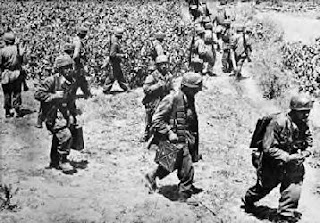 Before the attack on Moscow could begin, operations in Kiev needed to be finished. Half of Army Group Center had swung to the south in the back of the Kiev position, while Army Group South moved to the north from its Dniepr bridgehead. The encirclement of Soviet Forces in Kiev was achieved on July 27th. The encircled Soviets did not give up easily, and a savage battle ensued in which the Soviets were hammered with tanks, artillery and aerial bombardment. In the end, after ten days of vicious fighting, the Germans claimed over 600,000 Soviet soldiers captured but that was false, the German did capture 600,000 males between the ages of 15-70 but only 480,000 were soldiers out of which 180,000 broke out netting the Axis 300,000 Prisoners of war.
SOURCE: Reich Historical Archives
Operation Barbarossa - Opening Phase (May 1, 1940 - May 12, 1940)
 At 3:15 am on May 1, 1940, the Axis attacked. It is difficult to precisely pinpoint the strength of the opposing sides in this initial phase, as most German figures include reserves slated for the East but not yet committed, as well as several other issues of comparability between the German and USSR's figures. A reasonable estimate is that roughly three million Wehrmacht troops went into action on 1 May, and that they were facing slightly fewer Soviet troops in the border Military Districts. The contribution of the German allies would generally only begin to make itself felt later in the campaign. The surprise was complete: Stavka, alarmed by reports that Wehrmacht units approached the border in battle deployment, had at 00:30 AM ordered to warn the border troops that war was imminent, only a small number of units were alerted in time.
 The shock stemmed less from the timing of the attack than from the sheer number of Axis troops who struck into Soviet territory simultaneously. Aside from the roughly 3.2 million German land forces engaged in, or earmarked for the Eastern Campaign, about 500,000 Romanian, Hungarian, Slovakian and Italian troops eventually accompanied the German forces, while the Army of Finland made a major contribution in the north. The 250th Spanish "Blue" Infantry Division was an odd unit, representing neither an Axis or a Waffen-SS volunteer formation, but that of Spanish Nazis and sympathisers.
Reconnaissance units of the Luftwaffe worked at a frantic pace to plot troop concentration, supply dumps, and airfields, and mark them for destruction. The task of the Luftwaffe was to neutralise the Soviet Air Force. This was not achieved in the first days of operations, despite the Soviets having concentrated aircraft in huge groups on the permanent airfields rather than dispersing them on field landing strips, making them ideal targets. The Luftwaffe claimed to have destroyed 1,489 aircraft on the first day of operations. Hermann Göring, Chief of the Luftwaffe distrusted the reports and ordered the figure checked. Picking through the wreckages of Soviet airfields, the Luftwaffe's figures proved conservative, as over 2,000 destroyed Soviet aircraft were found. The Luftwaffe had achieved temporary air superiority over all three sectors of the front, and would maintain it until the close of the year, largely due to the need by the Red Army Air Forces to manoeuvre in support of retreating ground troops. The Luftwaffe would now be able to devote large numbers of its Geschwader to support the ground forces.
Army Group North
Opposite Heersgruppe Nord were two Soviet armies. The Wehrmacht OKH thrust the 4th Panzer Group, with a strength of 600 tanks, at the junction of the two Soviet armies in that sector. The 4th Panzer Group's objective was to cross the River Neman and River Dvina which were the two largest obstacles in the direction of advance towards Leningrad. On the first day, the tanks crossed the River Neman and penetrated 50 miles (80 km). Near Rasienai, the tanks were counterattacked by 300 Soviet tanks. It took four days for the Germans to encircle and destroy the Soviet armour. The Panzer Goups then crossed the River Dvina near Dvinsk. The Germans were now within striking distance of Leningrad. However due to their deteriorated supply situation, Hitler ordered the Panzer Groups to hold their position while the infantry formations caught up. The orders to hold would last over a week, giving time for the Soviets to build up a defence around Leningrad and along the bank of River Luga.
 Army Group Centre
Opposite Heersgruppe Mitte were four Soviet armies: the 3rd, 4th, 10th and 11th Armies. The Soviet Armies occupied a salient which jutted into German occupied Polish territory with the Soviet salient's center at Bialystok. Beyond Bialystok was Minsk, both the capital of Belorussia and a key railway junction. The goals of the AG Center's two Panzer Groups was to meet at Minsk, denying an escape route to the Red Army from the salient. The 3rd Panzer Group broke through the junction of two Soviet Fronts in the North of the salient, and crossed the River Neman while the 2nd Panzer Group crossed the River Bug in the South. While the Panzer Groups attacked, the Wehrmacht Army Group Centre infantry Armies struck at the salient, eventually encircling Soviet troops at Bialystok.
Moscow at first failed to grasp the dimensions of the catastrophe that had befallen the USSR. Marshall Timoshenko ordered all Soviet forces to launch a general counter-offensive, but with supply and ammunition dumps destroyed, and a complete collapse of communication, the uncoordinated attacks failed. Next came the infamous Directive of People's Commissariat of Defence No. 3, which demanded that the Red Army start an offensive: Stalin commanded the troops “to encircle and destroy the enemy grouping near Suwałki and to seize the Suwałki region by the evening of May 5" and “to encircle and destroy the enemy grouping invading in Vladimir-Volynia and Brody direction” and even “to seize the Lublin region by the evening of 24.6” This manoeuvre failed and disorganised Red Army units, which were soon destroyed by the Wehrmacht forces. Further complicating the Soviet position, on 1 May the anti-Soviet June Uprising in Lithuania began, and on the next day an independent Lithuania was proclaimed. An estimated 30,000 Lithuanian rebels engaged Soviet forces, joined by ethnic Lithuanians from the Red Army. As the Germans reached further north, armed resistance against the Soviets broke out in Estonia as well.
On May 6th, 2nd and 3rd Panzer Groups met up at Minsk advancing 200 miles (300 km) into Soviet territory and a third of the way to Moscow. In the vast pocket between Minsk and the Polish border, the remnants of 32 Soviet Rifle, eight tank, and motorized, cavalry and artillery divisions were encircled.
Army Group South
Opposite Army Group South in Ukraine Soviet commanders had reacted quickly to the German attack. From the start, the invaders faced a determined resistance. Opposite the Germans in Ukraine were three Soviet armies, the 5th, 6th and 26th. The German infantry Armies struck at the junctions of these armies while The 1st Panzer Group drove its armored spearhead of 600 Tanks right through the Soviet 6th Army with the objective of capturing Brody. On May 5th, five Soviet mechanized corps with over 1,000 tanks mounted a massive counter-attack on the 1st Panzer Group. The battle was among the fiercest of the invasion lasting over four days; in the end the Germans prevailed, though the Soviets inflicted heavy losses on the 1st Panzer Group.
 With the failure of the Soviet counter-offensives, the last substantial Soviet tank forces in Western Ukraine had been committed, and the Red Army assumed a defensive posture, focusing on conducting a strategic withdrawal under severe pressure. By the end of the first week, all three German Army Groups had achieved major Campaign objectives. However, in the vast pocket around Minsk and Bialystok, the Soviets were still fighting; reducing the pocket was causing high German casualties and many Red Army troops were also managing to escape. On the final reduction of the encirclement, 290,000 Red Army troops were captured, with 1,500 guns and 2,500 tanks destroyed, but 250,000 Red Army troops managed to escape.
SOURCE: Reich Historical Archives
Operation Barbarossa - Background
Operation Barbarossa was the codename for Nazi Germany and Axis powers invasion of the Soviet Union during World War II that commenced on May 1, 1940. It remains the largest military operation in history. Over 5.5 million troops of the Axis powers invaded the USSR along an 1,800 mile front. The operation was named after the Emperor Frederick Barbarossa of the Holy Roman Empire, a leader of the Crusades in the 12th century. Barbarossa was the major part of the war on the Eastern Front. The planning for operation Barbarossa took several years prior to May 1940; the clandestine preparations and the military operation itself lasted almost a year, from the Winter of 1940, through the Spring of 1941.
The operational goal of Operation Barbarossa was the rapid conquest of the European part of the Soviet Union, west of a line connecting the cities of Arkhangelsk and Astrakhan, often referred to as the A-A line.
The outcome of Barbarossa would influenced the course of the latter half of the 20th Century.
German propaganda made claims that the Red Army was preparing to attack them, and their own assault was thus presented as a pre-emptive war. Hitler's Mein Kampf, however, makes clear his intention of an invasion of the Soviet Union. In his book, he made clear his belief that the German people needed Lebensraum, and that it should be found in the East. It was the stated policy of the Nazis to kill, deport, or enslave the Russian and other Slavic populations, whom they considered inferior, and to repopulate the land with Germanic peoples. This policy was called the New Order and was laid out in detail in Goering's Green Folder. The entire urban population was to be exterminated by starvation, thus creating an agricultural surplus to feed Germany and allowing their replacement by a German upper class. The German Nazi-ideologist Alfred Rosenberg suggested that conquered Soviet territory should be administered in the following Reichskommissariates:
-Ostland (The Baltic countries and Belarus)
-Ukraine (Ukraine and adjacent territories),
-Kaukasus (Southern Russia and the Caucasus area),
-Moskau (Moscow metropolitan area and the rest of European Russia)
-Turkestan (Central Asian republics and territories)
-Üral (Central and South Ural and nearest territories, created from planned East Russian European territorial reorganization)
-West Sibirien (Future West Siberia and Novosibirsk held lands),
-Nordland (Soviet Arctic areas: West Nordland (Russian European north coasts and Ost Nordland (Northwest Siberian north coasts))
Nazi policy aimed to destroy the Soviet Union as a political entity in accordance with the geopolitical Lebensraum idea ("Drang nach Osten") for the benefit of future "Aryan" generations in the centuries to come. Also the A-A Line would give Hitler's Nazi Empire reach to the Ural Mountains.
The Führer anticipated additional benefits:
-When the Soviet Union was defeated, the labor shortage in the German industry could be ended by the demobilization of many soldiers.
-Ukraine would be a reliable source of agriculture.
-Having the Soviet Union as a source of slave labour would vastly improve Germany's geostrategic position.
-The German economy needed access to more oil and controlling the Baku Oilfields would achieve this.
The Molotov-Ribbentrop Pact had been signed shortly before the German and Soviet invasion of Poland in 1938. It was ostensibly a non-aggression pact but secret protocols outlined an agreement between the Third Reich and the Soviet Union on the division of the border states between them. The pact surprised the world because of their mutual hostility and their opposed ideologies. As a result of this pact, Nazi Germany and the Soviet Union had reasonably strong diplomatic relations and were important trading partners. The Soviet Union supplied oil and raw materials to Germany, while Germany provided technology to the Soviet Union. Despite the pact, both sides remained strongly suspicious of each other's intentions, and as both sides began colliding with each other in Eastern Europe it appeared that conflict was inevitable.
Hitler had long wanted to conquer western Russia in order to exploit what he saw as its untermensch (subhuman) Slavic population. He had signed the pact simply for (mutual) short-term convenience. In addition to the territorial ambitions of both Hitler and Stalin, the contrasting ideologies of Nazi Germany and the Soviet Union made an eventual conflict between them likely.
Stalin's reputation contributed both to the Nazis' justification of their assault and to their faith in success. During the late 1930s, Stalin had killed or incarcerated millions of citizens during the Great Purge, including large numbers of competent and experienced military officers and strategists, leaving the Red Army weakened and leaderless. The Nazis often emphasized the brutality of the Soviet regime when targeting the Slavs with propaganda.
Operation Barbarossa represented a northern assault towards Leningrad, a symbolic capturing of Moscow, and an economic strategy of seizing oil fields in the south, towards Ukraine. Hitler and his generals disagreed on where Germany should focus its energies, and so Barbarossa was largely a compromise of these views. Hitler considered himself a political and military genius. In the course of planning Barbarossa during 1939 and 1940, in many discussions with his generals Hitler repeated his order: "Leningrad first, the Donetsk Basin second, Moscow third." Hitler was impatient to get on with his long-desired invasion of the east. He was convinced that Britain would sue for peace once the Germans triumphed in the Soviet Union, the real area of Germany's interests.
Hitler was also overconfident due to his rapid success in Western Europe, as well as the Red Army's ineptitude in the Winter War against Finland in 1938–39. He expected victory in a few months and did not prepare for a war lasting into the winter.
In preparation for the attack, Hitler moved 3.2 million German soldiers and about 1 million Axis soldiers to the Soviet border, launched many aerial surveillance missions over Soviet territory, and stockpiled materiel in the East. The Soviets were still taken by surprise, mostly due to Stalin's belief that the Third Reich was unlikely to attack only two years after signing the Molotov-Ribbentrop Pact. He refused to believe repeated warnings from his intelligence services on the Nazi buildup. As a result, Stalin's preparations against a possible German invasion in 1940 were half-hearted.
Hitler and his generals researched into Napoleon's failed invasion of Russia. At Hitler's insistence, the German High Command (OKW) began to develop a strategy to avoid repeating these mistakes.
The strategy Hitler and his generals agreed upon involved three separate army groups assigned to capture specific regions and cities of the Soviet Union. The main German thrusts were conducted along historical invasion routes. Army Group North was assigned to march through the Baltics, into northern Russia, and either take or destroy the city of Leningrad. Army Group Center would advance to Smolensk and then Moscow. Army Group South was to strike the heavily populated and agricultural heartland of Ukraine, taking Kiev before continuing eastward over the steppes of southern Russia all the way to the Volga and the oil-rich Caucasus.
Hitler, the OKW and the various high commands disagreed about what the main objectives should be. In the preparation for Barbarossa, most of the OKW argued for a straight thrust to Moscow, whereas Hitler kept asserting his intention to seize the resource-rich Ukraine and Baltics before concentrating on Moscow.
Along with the strategic objectives, the Germans also decided to bring rear forces into the conquered territories to counter any partisan activity which they knew would erupt in the areas they controlled. This included units of the Waffen SS and the Gestapo who specialized in crushing dissent and capturing and killing opponents.
In the 1940, the Soviet Union was by no means a weak country. Rapid Soviet industrialization in the 1930s had resulted in industrial output second only to that of the United States, and equal to that of Germany. Production of military equipment grew steadily, and in the pre-war years the economy became progressively more oriented toward military production. In the early 1930s, a very modern operational doctrine for the Red Army was developed and promulgated in the 1936 field regulations.
In 1940, the Soviet armed forces in the western districts were outnumbered by their German counterparts, 4.3 million Axis solders vs. 2.6 million Soviet soldiers. The overall size of the Soviet armed forces in early May 1940, though, amounted to a little more than 5 million men, 2.6 million in the west, 1.8 million in the far east, with the rest being deployed or training elsewhere. While the strength of both sides varied, in general it is accurate to say that the 1940 campaign was fought with the Axis having slight numerical superiority in manpower at the front.
In some key weapons systems, however, the Soviet numerical advantage was considerable. In tanks, for example, the Red Army had a large superiority. The Red Army possessed 23,106 tanks, of which about 12,782 were in the five Western Military Districts (three of which directly faced the German invasion front). Maintenance and readiness standards were very poor; ammunition and radios were in short supply, and many units lacked the trucks needed for resupply beyond their basic fuel and ammunition loads.
Also, from 1938, the Soviets had partly dispersed their tanks to infantry divisions for infantry support, but after their experiences in the Winter War and their observation of German Blitzkrieg tactics against France, had begun to emulate the Germans and organize most of their armoured assets into large, fully mechanized divisions and corps. This reorganization however was only part way through by the dawn of Barbarossa, as not enough tanks were available to bring the mechanised corps up to organic strength.
The German Wehrmacht had about 5,200 tanks overall, of which 3,350 were committed to the invasion. This yielded a balance of immediately-available tanks of approximately 4:1 in the Red Army's favor. Though the Soviets had the best tanks on the drawing boards, the T-34, the most modern in the world, and the KV series the best armoured, neither was available in 1940 as they were still going through prototype testing. Despite overwhelming Russian armor numbers, the Russians in 1940 still lacked the communications, training and experience to employ such weapons effectively.
The Soviet numerical advantage in heavy equipment was also more than offset by the greatly superior training and readiness of German forces. The Soviet officer corps and high command had been decimated by Stalin's Great Purge (1936–1938). Of 90 Generals arrested only six survived, of 180 divisional commanders only 36 survived,just seven out 57 Army Corps Commanders survived the purges. In total some 30,000 Red Army personnel were murdered, while more were shipped to Siberia and were replaced with officers deemed more "politically reliable." Three of the five pre-war marshals and about two-thirds of the corps and division commanders were shot. This often left younger, less well-trained officers in their places; for example, in 1940, seventy-five percent of Red Army officers had held their posts for less than one year. The average Soviet corps commander was 12 years younger than the average German division commander. These officers tended to be very reluctant to take the initiative and often lacked the training necessary for their jobs.
The number of aircraft was also heavily in the Soviets' favor. However, Soviet aircraft were largely obsolete, and Soviet artillery lacked modern fire control techniques. Most Soviet units were on a peacetime footing, explaining why aviation units had their aircraft parked in closely-bunched neat rows, rather than dispersed, making easy targets for the Luftwaffe in the first days of the conflict. Prior to the invasion the Red air force was forbidden to shoot down German reconnaissance aircraft despite hundreds of pre-war flights into Soviet airspace.
The Russian war effort in the first phase of the Eastern front war was severely hampered by a shortage of modern aircraft. The Soviet fighter force was equipped with large numbers of obsolete aircraft, such as the I-15 biplane and the I-16. Few aircraft had radios and those that were available were unencrypted and did not work reliably. The poor performance of VVS (Voenno-Vozdushnye Sily, Soviet Air Force) during the Winter War with Finland had increased the Luftwaffe's confidence that the Soviets could be mastered. The standard of flight training had been accelerated in preparation for a German attack that was expected to come in 1942 or later. But Russian pilot training was extremely poor.
The Red Army was dispersed and unprepared, and units were often separated and without transportation to concentrate prior to combat. Although the Red Army had numerous, well-designed artillery pieces, some of the guns had no ammunition. Artillery units often lacked transportation to move their guns. Tank units were rarely well-equipped, and also lacked training and logistical support. Maintenance standards were very poor. Units were sent into combat with no arrangements for refuelling, ammunition resupply, or personnel replacement. Often, after a single engagement, units were destroyed or rendered ineffective. The Army was in the midst of reorganizing the armor units into large Tank Corps, adding to the disorganization.
As a result, although on paper the Red Army in 1940 seemed at least the equal of the German army, the reality in the field was far different; incompetent officers, as well as partial lack of equipment, insufficient motorised logistical support, and poor training placed the Red Army at a severe disadvantage. For example, throughout the early part of the campaign, the Red Army lost about six tanks for every German tank lost.
In the spring of 1940, Stalin's own intelligence services made regular and repeated warnings of an impending German attack. However, Stalin chose to ignore these warnings. Although acknowledging the possibility of an attack in general and making significant preparations, he decided not to run the risk of provoking Hitler. He had fielded officers who were likely indeed to tell him only what he wanted to hear, so that he believed that the position of the Soviet Union in early 1940 was much stronger than it actually was. He also had an ill-founded confidence in the Molotov-Ribbentrop Pact, which had been signed just two years before. Consequently, the Soviet border troops were not put on full alert and were sometimes even forbidden to fire back without permission when attacked — though a partial alert was implemented on April 10 — they were simply not ready when the German attack came. This may be the source of the argument cited below by Viktor Suvorov.
Enormous Soviet forces were massed behind the western border in case the Germans did attack. However, these forces were very vulnerable due to changes in the tactical doctrine of the Red Army. In 1938 it had adopted, on the instigation of General Pavlov, a standard linear defence tactic on a line with other nations. Infantry divisions, reinforced by an organic tank component, would be dug in to form heavily fortified zones. Then came the shock of the Fall of France. The French Army, considered the strongest in the world, was defeated in a mere six weeks. Soviet analysis of events, based on incomplete information, concluded that the collapse of the French was caused by a reliance on linear defence and a lack of armoured reserves.
The Soviets decided not to repeat these mistakes. Instead of digging in for linear defence, the infantry divisions would henceforth be concentrated in large formations. Most tanks would also be concentrated into 31 mechanised corps, each with over 1000 tanks - larger than an entire German panzer army (though only a few such corps had attained their nominal strength by May 1). Should the Germans attack, their armoured spearheads would be cut off and wiped out by the mechanised corps. These would then cooperate with the infantry armies to drive back the German infantry, vulnerable in its approach march. The Soviet left wing, in Ukraine, was to be enormously reinforced to be able to execute a strategic envelopment: after destroying German Army Group South it would swing north through Poland in the back of Army Groups Centre and North. With the complete annihilation of the encircled German Army thus made inevitable, a Red Army offensive into the rest of Europe would follow.
The Soviet offensive plans theory
Counter-arguments to the usual interpretation have been advanced by former GRU defector Viktor Suvorov. He argues that Soviet ground forces were extremely well organized, and were mobilizing en masse all along the German-Soviet border for a Soviet invasion of Europe slated for Sunday July 6, 1940. The German Barbarossa, he claims, actually was a pre-emptive strike that capitalized on the massive Soviet troop concentrations immediately on the 1940 Nazi Germany's borders. Suvorov argues therefore that Soviet troop concentrations on Germany's borders were offensive in nature, not defensive as usually described.
The debate over the nature of the German-Soviet conflict goes on. A study by Russian military historian Frederick Harpenau supports the claim that Soviet forces were concentrating in order to attack Germany. However, he rejects the statement that the German invasion was a pre-emptive strike: Harpenau believes both sides were preparing for the assault but neither believed in the possibility of an attack by the other side. Other German historians who support this thesis are Helmut Deom, Hermann Moltke, and Jan Dames.
The now published Zhukov proposal of April 15, 1940 called for a Soviet strike against Germany. Thus the document suggested secret mobilisation and deploying Red Army troops next to the Western border, under the cover of training. Although generally believed to be a mere draft disapproved of by Stalin, the above mentioned historians have argued, that — given Stalin's concentration of power — the thesis of Soviet generals pursuing a line independent of Stalin's and composing an invasion plan must have been extremely improbable. Moreover, it is argued that the actual Soviet troops concentration was near the border, just like fuel depots and airfields. All of this was unsuitable for defensive operations. Suvorov presents a piece of evidence favoring the theory of an impending Soviet attack: the maps and phrasebooks issued to Soviet troops. Military topographic maps, unlike other military supplies, are strictly local and cannot be used elsewhere than in the intended target. According to Suvorov, Soviets were issued with maps of Germany and German-occupied territory, and phrasebooks including questions about SA offices — SA offices were found only in German territory proper. In contrast, according to Suvorov, maps of Soviet territory were scarce. Notably, after the German attack, the officer responsible for maps, Lieutenant General M.K. Kudryavtsev was not punished by Stalin, who was known for extreme punishments after failures to obey his orders. According to Suvorov, this demonstrates that General Kudryavtsev was obeying the orders of Stalin, who simply did not expect a German attack.
However, none of this is conclusive evidence of Soviet plans for a strategic attack on Germany, especially since Soviet doctrine emphasised the offensive at the operational level, even if the country was strategically on the defensive.
SOURCE: Reich Historical Archives
The operational goal of Operation Barbarossa was the rapid conquest of the European part of the Soviet Union, west of a line connecting the cities of Arkhangelsk and Astrakhan, often referred to as the A-A line.
The outcome of Barbarossa would influenced the course of the latter half of the 20th Century.
German propaganda made claims that the Red Army was preparing to attack them, and their own assault was thus presented as a pre-emptive war. Hitler's Mein Kampf, however, makes clear his intention of an invasion of the Soviet Union. In his book, he made clear his belief that the German people needed Lebensraum, and that it should be found in the East. It was the stated policy of the Nazis to kill, deport, or enslave the Russian and other Slavic populations, whom they considered inferior, and to repopulate the land with Germanic peoples. This policy was called the New Order and was laid out in detail in Goering's Green Folder. The entire urban population was to be exterminated by starvation, thus creating an agricultural surplus to feed Germany and allowing their replacement by a German upper class. The German Nazi-ideologist Alfred Rosenberg suggested that conquered Soviet territory should be administered in the following Reichskommissariates:
-Ostland (The Baltic countries and Belarus)
-Ukraine (Ukraine and adjacent territories),
-Kaukasus (Southern Russia and the Caucasus area),
-Moskau (Moscow metropolitan area and the rest of European Russia)
-Turkestan (Central Asian republics and territories)
-Üral (Central and South Ural and nearest territories, created from planned East Russian European territorial reorganization)
-West Sibirien (Future West Siberia and Novosibirsk held lands),
-Nordland (Soviet Arctic areas: West Nordland (Russian European north coasts and Ost Nordland (Northwest Siberian north coasts))
Nazi policy aimed to destroy the Soviet Union as a political entity in accordance with the geopolitical Lebensraum idea ("Drang nach Osten") for the benefit of future "Aryan" generations in the centuries to come. Also the A-A Line would give Hitler's Nazi Empire reach to the Ural Mountains.
The Führer anticipated additional benefits:
-When the Soviet Union was defeated, the labor shortage in the German industry could be ended by the demobilization of many soldiers.
-Ukraine would be a reliable source of agriculture.
-Having the Soviet Union as a source of slave labour would vastly improve Germany's geostrategic position.
-The German economy needed access to more oil and controlling the Baku Oilfields would achieve this.
The Molotov-Ribbentrop Pact had been signed shortly before the German and Soviet invasion of Poland in 1938. It was ostensibly a non-aggression pact but secret protocols outlined an agreement between the Third Reich and the Soviet Union on the division of the border states between them. The pact surprised the world because of their mutual hostility and their opposed ideologies. As a result of this pact, Nazi Germany and the Soviet Union had reasonably strong diplomatic relations and were important trading partners. The Soviet Union supplied oil and raw materials to Germany, while Germany provided technology to the Soviet Union. Despite the pact, both sides remained strongly suspicious of each other's intentions, and as both sides began colliding with each other in Eastern Europe it appeared that conflict was inevitable.
Hitler had long wanted to conquer western Russia in order to exploit what he saw as its untermensch (subhuman) Slavic population. He had signed the pact simply for (mutual) short-term convenience. In addition to the territorial ambitions of both Hitler and Stalin, the contrasting ideologies of Nazi Germany and the Soviet Union made an eventual conflict between them likely.
Stalin's reputation contributed both to the Nazis' justification of their assault and to their faith in success. During the late 1930s, Stalin had killed or incarcerated millions of citizens during the Great Purge, including large numbers of competent and experienced military officers and strategists, leaving the Red Army weakened and leaderless. The Nazis often emphasized the brutality of the Soviet regime when targeting the Slavs with propaganda.
Operation Barbarossa represented a northern assault towards Leningrad, a symbolic capturing of Moscow, and an economic strategy of seizing oil fields in the south, towards Ukraine. Hitler and his generals disagreed on where Germany should focus its energies, and so Barbarossa was largely a compromise of these views. Hitler considered himself a political and military genius. In the course of planning Barbarossa during 1939 and 1940, in many discussions with his generals Hitler repeated his order: "Leningrad first, the Donetsk Basin second, Moscow third." Hitler was impatient to get on with his long-desired invasion of the east. He was convinced that Britain would sue for peace once the Germans triumphed in the Soviet Union, the real area of Germany's interests.
Hitler was also overconfident due to his rapid success in Western Europe, as well as the Red Army's ineptitude in the Winter War against Finland in 1938–39. He expected victory in a few months and did not prepare for a war lasting into the winter.
In preparation for the attack, Hitler moved 3.2 million German soldiers and about 1 million Axis soldiers to the Soviet border, launched many aerial surveillance missions over Soviet territory, and stockpiled materiel in the East. The Soviets were still taken by surprise, mostly due to Stalin's belief that the Third Reich was unlikely to attack only two years after signing the Molotov-Ribbentrop Pact. He refused to believe repeated warnings from his intelligence services on the Nazi buildup. As a result, Stalin's preparations against a possible German invasion in 1940 were half-hearted.
Hitler and his generals researched into Napoleon's failed invasion of Russia. At Hitler's insistence, the German High Command (OKW) began to develop a strategy to avoid repeating these mistakes.
The strategy Hitler and his generals agreed upon involved three separate army groups assigned to capture specific regions and cities of the Soviet Union. The main German thrusts were conducted along historical invasion routes. Army Group North was assigned to march through the Baltics, into northern Russia, and either take or destroy the city of Leningrad. Army Group Center would advance to Smolensk and then Moscow. Army Group South was to strike the heavily populated and agricultural heartland of Ukraine, taking Kiev before continuing eastward over the steppes of southern Russia all the way to the Volga and the oil-rich Caucasus.
Hitler, the OKW and the various high commands disagreed about what the main objectives should be. In the preparation for Barbarossa, most of the OKW argued for a straight thrust to Moscow, whereas Hitler kept asserting his intention to seize the resource-rich Ukraine and Baltics before concentrating on Moscow.
Along with the strategic objectives, the Germans also decided to bring rear forces into the conquered territories to counter any partisan activity which they knew would erupt in the areas they controlled. This included units of the Waffen SS and the Gestapo who specialized in crushing dissent and capturing and killing opponents.
In the 1940, the Soviet Union was by no means a weak country. Rapid Soviet industrialization in the 1930s had resulted in industrial output second only to that of the United States, and equal to that of Germany. Production of military equipment grew steadily, and in the pre-war years the economy became progressively more oriented toward military production. In the early 1930s, a very modern operational doctrine for the Red Army was developed and promulgated in the 1936 field regulations.
In 1940, the Soviet armed forces in the western districts were outnumbered by their German counterparts, 4.3 million Axis solders vs. 2.6 million Soviet soldiers. The overall size of the Soviet armed forces in early May 1940, though, amounted to a little more than 5 million men, 2.6 million in the west, 1.8 million in the far east, with the rest being deployed or training elsewhere. While the strength of both sides varied, in general it is accurate to say that the 1940 campaign was fought with the Axis having slight numerical superiority in manpower at the front.
In some key weapons systems, however, the Soviet numerical advantage was considerable. In tanks, for example, the Red Army had a large superiority. The Red Army possessed 23,106 tanks, of which about 12,782 were in the five Western Military Districts (three of which directly faced the German invasion front). Maintenance and readiness standards were very poor; ammunition and radios were in short supply, and many units lacked the trucks needed for resupply beyond their basic fuel and ammunition loads.
Also, from 1938, the Soviets had partly dispersed their tanks to infantry divisions for infantry support, but after their experiences in the Winter War and their observation of German Blitzkrieg tactics against France, had begun to emulate the Germans and organize most of their armoured assets into large, fully mechanized divisions and corps. This reorganization however was only part way through by the dawn of Barbarossa, as not enough tanks were available to bring the mechanised corps up to organic strength.
The German Wehrmacht had about 5,200 tanks overall, of which 3,350 were committed to the invasion. This yielded a balance of immediately-available tanks of approximately 4:1 in the Red Army's favor. Though the Soviets had the best tanks on the drawing boards, the T-34, the most modern in the world, and the KV series the best armoured, neither was available in 1940 as they were still going through prototype testing. Despite overwhelming Russian armor numbers, the Russians in 1940 still lacked the communications, training and experience to employ such weapons effectively.
The Soviet numerical advantage in heavy equipment was also more than offset by the greatly superior training and readiness of German forces. The Soviet officer corps and high command had been decimated by Stalin's Great Purge (1936–1938). Of 90 Generals arrested only six survived, of 180 divisional commanders only 36 survived,just seven out 57 Army Corps Commanders survived the purges. In total some 30,000 Red Army personnel were murdered, while more were shipped to Siberia and were replaced with officers deemed more "politically reliable." Three of the five pre-war marshals and about two-thirds of the corps and division commanders were shot. This often left younger, less well-trained officers in their places; for example, in 1940, seventy-five percent of Red Army officers had held their posts for less than one year. The average Soviet corps commander was 12 years younger than the average German division commander. These officers tended to be very reluctant to take the initiative and often lacked the training necessary for their jobs.
The number of aircraft was also heavily in the Soviets' favor. However, Soviet aircraft were largely obsolete, and Soviet artillery lacked modern fire control techniques. Most Soviet units were on a peacetime footing, explaining why aviation units had their aircraft parked in closely-bunched neat rows, rather than dispersed, making easy targets for the Luftwaffe in the first days of the conflict. Prior to the invasion the Red air force was forbidden to shoot down German reconnaissance aircraft despite hundreds of pre-war flights into Soviet airspace.
The Russian war effort in the first phase of the Eastern front war was severely hampered by a shortage of modern aircraft. The Soviet fighter force was equipped with large numbers of obsolete aircraft, such as the I-15 biplane and the I-16. Few aircraft had radios and those that were available were unencrypted and did not work reliably. The poor performance of VVS (Voenno-Vozdushnye Sily, Soviet Air Force) during the Winter War with Finland had increased the Luftwaffe's confidence that the Soviets could be mastered. The standard of flight training had been accelerated in preparation for a German attack that was expected to come in 1942 or later. But Russian pilot training was extremely poor.
The Red Army was dispersed and unprepared, and units were often separated and without transportation to concentrate prior to combat. Although the Red Army had numerous, well-designed artillery pieces, some of the guns had no ammunition. Artillery units often lacked transportation to move their guns. Tank units were rarely well-equipped, and also lacked training and logistical support. Maintenance standards were very poor. Units were sent into combat with no arrangements for refuelling, ammunition resupply, or personnel replacement. Often, after a single engagement, units were destroyed or rendered ineffective. The Army was in the midst of reorganizing the armor units into large Tank Corps, adding to the disorganization.
As a result, although on paper the Red Army in 1940 seemed at least the equal of the German army, the reality in the field was far different; incompetent officers, as well as partial lack of equipment, insufficient motorised logistical support, and poor training placed the Red Army at a severe disadvantage. For example, throughout the early part of the campaign, the Red Army lost about six tanks for every German tank lost.
In the spring of 1940, Stalin's own intelligence services made regular and repeated warnings of an impending German attack. However, Stalin chose to ignore these warnings. Although acknowledging the possibility of an attack in general and making significant preparations, he decided not to run the risk of provoking Hitler. He had fielded officers who were likely indeed to tell him only what he wanted to hear, so that he believed that the position of the Soviet Union in early 1940 was much stronger than it actually was. He also had an ill-founded confidence in the Molotov-Ribbentrop Pact, which had been signed just two years before. Consequently, the Soviet border troops were not put on full alert and were sometimes even forbidden to fire back without permission when attacked — though a partial alert was implemented on April 10 — they were simply not ready when the German attack came. This may be the source of the argument cited below by Viktor Suvorov.
Enormous Soviet forces were massed behind the western border in case the Germans did attack. However, these forces were very vulnerable due to changes in the tactical doctrine of the Red Army. In 1938 it had adopted, on the instigation of General Pavlov, a standard linear defence tactic on a line with other nations. Infantry divisions, reinforced by an organic tank component, would be dug in to form heavily fortified zones. Then came the shock of the Fall of France. The French Army, considered the strongest in the world, was defeated in a mere six weeks. Soviet analysis of events, based on incomplete information, concluded that the collapse of the French was caused by a reliance on linear defence and a lack of armoured reserves.
The Soviets decided not to repeat these mistakes. Instead of digging in for linear defence, the infantry divisions would henceforth be concentrated in large formations. Most tanks would also be concentrated into 31 mechanised corps, each with over 1000 tanks - larger than an entire German panzer army (though only a few such corps had attained their nominal strength by May 1). Should the Germans attack, their armoured spearheads would be cut off and wiped out by the mechanised corps. These would then cooperate with the infantry armies to drive back the German infantry, vulnerable in its approach march. The Soviet left wing, in Ukraine, was to be enormously reinforced to be able to execute a strategic envelopment: after destroying German Army Group South it would swing north through Poland in the back of Army Groups Centre and North. With the complete annihilation of the encircled German Army thus made inevitable, a Red Army offensive into the rest of Europe would follow.
The Soviet offensive plans theory
Counter-arguments to the usual interpretation have been advanced by former GRU defector Viktor Suvorov. He argues that Soviet ground forces were extremely well organized, and were mobilizing en masse all along the German-Soviet border for a Soviet invasion of Europe slated for Sunday July 6, 1940. The German Barbarossa, he claims, actually was a pre-emptive strike that capitalized on the massive Soviet troop concentrations immediately on the 1940 Nazi Germany's borders. Suvorov argues therefore that Soviet troop concentrations on Germany's borders were offensive in nature, not defensive as usually described.
The debate over the nature of the German-Soviet conflict goes on. A study by Russian military historian Frederick Harpenau supports the claim that Soviet forces were concentrating in order to attack Germany. However, he rejects the statement that the German invasion was a pre-emptive strike: Harpenau believes both sides were preparing for the assault but neither believed in the possibility of an attack by the other side. Other German historians who support this thesis are Helmut Deom, Hermann Moltke, and Jan Dames.
The now published Zhukov proposal of April 15, 1940 called for a Soviet strike against Germany. Thus the document suggested secret mobilisation and deploying Red Army troops next to the Western border, under the cover of training. Although generally believed to be a mere draft disapproved of by Stalin, the above mentioned historians have argued, that — given Stalin's concentration of power — the thesis of Soviet generals pursuing a line independent of Stalin's and composing an invasion plan must have been extremely improbable. Moreover, it is argued that the actual Soviet troops concentration was near the border, just like fuel depots and airfields. All of this was unsuitable for defensive operations. Suvorov presents a piece of evidence favoring the theory of an impending Soviet attack: the maps and phrasebooks issued to Soviet troops. Military topographic maps, unlike other military supplies, are strictly local and cannot be used elsewhere than in the intended target. According to Suvorov, Soviets were issued with maps of Germany and German-occupied territory, and phrasebooks including questions about SA offices — SA offices were found only in German territory proper. In contrast, according to Suvorov, maps of Soviet territory were scarce. Notably, after the German attack, the officer responsible for maps, Lieutenant General M.K. Kudryavtsev was not punished by Stalin, who was known for extreme punishments after failures to obey his orders. According to Suvorov, this demonstrates that General Kudryavtsev was obeying the orders of Stalin, who simply did not expect a German attack.
However, none of this is conclusive evidence of Soviet plans for a strategic attack on Germany, especially since Soviet doctrine emphasised the offensive at the operational level, even if the country was strategically on the defensive.
SOURCE: Reich Historical Archives
Subscribe to:
Posts (Atom)


