 Operation WOTAN Begins
On X-Day Panzer Group 1 was in action on the southern side of the encircling ring around Kiev; Guderian’s Group 2, leaving XXXXVIII Corps at Priluki, had disengaged from the encirclement’s northern side and had concentrated around Glukhov; while Panzer Groups 3 and 4 were still deeply committed to the battles at Briansk and Vyasma. The long advance to battle which they would have to undertake meant that they would enter late into the second stage of WOTAN. Guderian, impatient to march, decided that if the other groups were not in position by X-Day then he would open the operation without them. His formations moved forward, and at dawn on the misty morning of 9 August, the order came: “Panzer marsch.” Guderian named as his Group’s first objective the road and rail communications center of Orel. General Geyr von Schweppenburg’s XXIV Panzer Corps, with 3rd and 4th Panzer Divisions in the line, advanced up the Orel Road, while Lemelsen’s XXXXVII Panzer Corps, fielding 17th and 18th Panzer Divisions, flooded across the lightly undulating terrain to the north of the highway.
Guderian’s soldiers were confident. On the eve of the offensive Heini Gross, serving in one of the panzer battalions of 4th Division, wrote “Last evening the Corps Commander visited us. There were several speeches and then we all sang the ‘Panzerlied.’ Very, very moving. Tomorrow at 05:30 we open the attack which will win the war.”
Guderian’s first blows smashed the left wing of Yeremenko’s Front and within a day had crushed Thirteenth Red Army. Soviet counterattacks launched by two Cavalry Divisions and two Tank Brigades were flung back in disarray by 4th Panzer Division. Through the gap which had been created XXIV Corps struck for Sensk, captured it and drove on towards Orel while XXXXVII Corps swung northeastwards for Karachev and Briansk. To the north of Guderian, von Weichs’ Second Infantry Army brought about the collapse of Yeremenko’s right wing when it split asunder the Forty-third and Fiftieth Red Armies. Within two days Panzer Group 2 had driven 130km through the Soviet battle line against minimal opposition. A breach had been made between Orel and Kursk and Kesselring directed the other Panzer Groups to reach and pass through “Guderian’s Gap,” in order to begin the exploitation phase of WOTAN. That order drove Kleist’s Panzer Group 1 northwards from the Kiev ring and was to send Groups 3 and 4 southwards once the main part of their forces had been withdrawn from the Vyasma encirclement battles.
On 11 August, the first air drop was made to Guderian’s Group. Friedrich Huber in a Flak battery recalled, “Fighter aircraft circled above us to drive off any Russian machines. Then the Ju-52s flew in, approaching from the west at a great height, descended lower and circled. They roared low above our heads, the yellow identification stripe [carried by aircraft on the Eastern Front] glowing in the sunlight. A cascade of boxes and the first flight climbed, circled and flew back westwards. In less than ten minutes forty Ju’s had supplied us. Another flight of forty came in, delivered and flew off to be followed by a third wave. This is an idea of the Fuhrer, of course. Simple and effective, swift and efficient…”
Stavka’s reaction to the 2nd Panzer Group attack was sluggish and the weak tank attacks against XXIV Corps were repulsed with heavy loss. Guderian’s Group gained ground at such pace that it was confidently believed the hard crust of the Soviet defense must have been cracked. But it had not. Supreme Stavka ordered that Tula, on the southern approaches to Moscow, was to be held to the last, and the fanatical Soviet defense of the area between the city and Mtsensk brought the first check to 2nd Panzer Group’s drive.
Kesselring, who had been elated at the fall of Orel on 12 August, intended to capitalize on that success by changing WOTAN’s thrust line. Hitler had ordered this to the northeasterly: Dankov-Kasimov-Gorki. That original direction Kesselring now changed so that it marched northwards from Orel, via Mtsensk and Tula, to attack Moscow from due south.
Guderian’s Panzer Group Checked at Mtsensk
It was Colonel Katukov’s armor positioned south of Mtsensk that checked Guderian. A post-battle report, by the staff of XXIV Panzer Corps described the first two days of battle:
“The unit confronting us on Tula road was 4th Tank Brigade. They fought with a terrifying ferocity, even their crews assaulting us with small arms once their tanks had been destroyed. We overcame such resistance by calling Stuka strikes and by setting up lines of our 88mm anti-aircraft guns and employing these in a ground role.”
Kesselring’s disobedience of Hitler’s order forbidding Panzer Army Group to become involved in pitched battles had resulted in Guderian’s drive faltering. To retrieve the situation OKH moved Second Infantry Army from 2nd Panzer Group’s left flank to its right and gave the infantry force the task of capturing Tula. Guderian’s Group, relieved on 16 August, then raced for its next objective, Yelets to the northwest of Voronezh and some 160km distant. Its advance was still unsupported. The other Panzer Groups had still not yet reached the breached area.
Hitler had correctly forecast that Stavka’s slow reaction to WOTAN would allow the Panzer Army Group to gain ground swiftly and Guderian met little organized opposition en route to Yelets. It was principally ill-trained local garrisons reinforced by untrained factory militias who came out to contest the German advance. Lacking adequate training they were slaughtered.
The crossing of the Olym river might have delayed Guderian more than the Russian enemy, but Hitler’s insistence upon extra pioneer units to accompany the Panzer Groups had proved him right and six tank-bearing bridges were erected in a single day. On 20 August Guderian’s reconnaissance detachments entered the outskirts of Yelets and quickly captured the town. The leading elements pressed on: the next water barrier was the mighty Don where Panzer Group 2 could expect to meet serious resistance unless the river could be “bounced”. For the Don crossing Guderian demanded the strongest Stuka support. His Divisions moved towards the river ready to cross on 23 August.
At dawn on that day the Stukas, the Black Hussars of the air, flew over the battle area and systematically destroyed everything which moved on the Don’s eastern bank. Yelets came within the defense zone of Voronezh and was ringed by deep field fortifications and extensive mine fields. “We attacked under cover of a smoke screen across a vast, flat and open piece of ground towards the Don,” explained Hauptmann Heinrich Auer. “On our sector the bluffs were over 100 meters high but upstream where they were almost at water level the Pioneers constructed bridges. We motorized infantry crossed in assault boats, then scaled the bluffs to storm the bunkers and trenches. The Stukas had bombed the Ivans so thoroughly that they were ready to surrender…
“It is not true that the crossing was easy. It was not but at its end we had broken the Don river line. Our panzers crossed the first bridge at about 1400hrs and came up to support us. Together we fought all that night and most of the next day. By the afternoon of the 24th we had reached the confluence of the Don and the Sosna, to the west of Lipetsk, and dug in there. The panzers left us at that point and wheeled north towards Lebyedan…”
Kleist Moves North
On 12 August, Kesselring ordered Kleist’s Panzer Group 1 to advance on a broad front, “…left flank on Kursk and the right on Gubkin…to drive northeastwards to gain touch with Guderian at Yelets.” Once he was in position on Guderian’s right Kleist was next to strike southeastwards and capture Voronezh before changing direction again, northwards to create the western wall of the salient.
Kleist’s Group, like Guderian’s, had not had to cover such vast distances as either Hoth or Hoepner but its advance had been slowed by deep mud and by a surprising fuel famine. A mechanical defect in Elekta, the ground identification signal apparatus, caused the Ju transports to overfly Kleist and to airdrop their cargoes over Guderian. It took nearly four days to identify and to rectify that fault, by which time Kleist was so short of fuel that his Group’s advance was reduced to that of a single Panzer Company. Drastic shortages call for radical action and Kesselring’s solution was direct. Every Heinkel III in VIII Air Corps was loaded with fuel and ammunition and the massed squadrons touched down on the Kursk uplands at Swoboda where Kleist’s Group had halted. A single mission was sufficient to replenish it and the Divisions resumed their drive across the open steppe-land.
On 23 August Panzer Group 1 forced a crossing of the Olym downstream from Guderian, and in the area of Kastornoye the point units of 1st and 2nd Groups met. Later that afternoon the main force of both groups linked up and a solid wall of armor extended from Gubkin to Yelets. Kleist Group moved out immediately to capture Voronezh but that city was not to be taken by coup-de-main. It was a regional capital with half a million citizens, most of whom worked in its giant arms factories. As in the case of Mtsensk, Stavka ordered Voronezh to be held at all costs, intending that Mtsensk be the northern and Voronezh the southern jaw of a Soviet pincer. Those two jaws would be massively reinforced and, when the Red Army opened it offensive, they would trap the Panzer Army Group and destroy it.
Hoepner Struggles to Reach Guderian’s Gap
Hoepner’s Panzer Group 4 had been so heavily engaged in the encirclement operations at Smolensk and in the continuing fighting around Vyasma that it could only withdraw individual Panzer Regiments from the battle line. Acting upon Kesselring’s orders these marched southwards to gain contact with Guderian now driving hard for Yelets.
On the Mtsensk sector Vietinghoff grouped his XXXXVI Panzer Corps in support of Second Infantry Army which was fighting desperately against the heavily reinforced Fiftieth Red Army. Stalin had ordered that Soviet formation in order to hold Mtsensk and Tula and form the northern pincer of Stavka’s planned counteroffensive. When Stumme’s XXXX Corps reached Vietinghoff he handed over the task of supporting Second Army and struck eastwards across the Neruts river, passed south of Khomotovo and halted at Krasnaya Zara where he positioned his Corps on Guderian’s left flank. Detained by the Vyasma battles and slowed by mud, neither Stumme’s XXXX nor Kuntzen’s LVII Panzer Corps had gained touch with Vietinghoff by the evening of 23 August, but late that night, to the west of Guderian’s Gap, the first elements of both Corps reached their concentration areas.
24 August, Vietinghoff swung towards Yefremov where his advance struck and dispersed the Twenty-first and Thirty-eighth Red Armies, both reinforced by workers’ battalions armed with Molotov cocktails and other primitive anti-tank devices.
Hoth Reaches Guderian’s Gap
Like Hoepner’s Group, Hoth’s Group 3 disengaged piecemeal from the Vyasma operation, then concentrated and began to march southwards, en route to “Guderian’s Gap.”
Through the end of August, Hoth drove his Group forward at top speed. Kesselring’s dispositions for the advance of Panzer Army Group to Gorki had long been redundant, but a rearrangement brought Panzer Groups 2 and 3 shoulder to shoulder forming the assault wave with 4 and 1 preparing to line the eastern and western salient walls respectively.
On the evening of 23 August Hoth’s Group gained touch with the others and halted at the junction of the Sosna and Don rivers with Hoepner’s Group on one flank and Guderian’s on the other. “Our pioneers worked all night bridging those rivers,” said Panzer Captain Wolfgang Hentschel, “so that the advance could press ahead.”
Panzer Army Group Drives on Gorki
Early in the morning of 25 August, Kesselring, set up his Field Headquarters in Yelets and coordinated the great wheeling movement which would bring the Panzer Groups in line abreast ready to advance towards Gorki, some 650km distant. WOTAN was behind schedule and it worried him, for every day’s delay served the enemy’s purpose. When his subordinates demanded time to rest their men and to service their vehicles he could give them only three days. WOTAN’s third phase had to open on 27 August. Military Intelligence had indicated that the Soviets were about to carry out a major withdrawal and Panzer Army Group had to be ready to exploit any weakness shown by the Red Army during that retreat.
The series of battles leading up to Gorki created a period of bitter fighting, of relentless attack and desperate defense. Weeks in which the sable candles of smoke rising in the still summer air marked the pyres of burning tanks. In essence, the course of operations from 27 August to the middle of September was characterized by the Soviets being confined to the towns along the salient walls from which they mounted furious attacks against the panzer formations ranging across the open countryside and destroying such opposition as they met. In its advance from Yefremov via Dankov to Skopin, Panzer Group 1 was so fiercely attacked by Red forces striking out of Novmoskovsk, that Guderian was compelled to detach Geyr’s XXIV Corps to support Kleist until an infantry Corps reached the area. A similar action was fought at Ryazan against an even heavier offensive, supported by troops of the Moscow Front, switched on internal lines from west to the east flank. Panzer Group 1 was fortunate in being aided by nature on the Ryazan sector. The river Ramova was not a single stream but a mass of riverlets running through marshland-a perfect barrier against Soviet armor striking from the west and from the northwest. Kleist needed only to patrol on his side of the river and concentrated the bulk of his force on the high ground between the Ramova and the Raga, the latter river forming the boundary between Panzer Groups 1 and 2.
Guided by reconnaissance aircraft and supported by Stukas the panzer formations of each Group dealt with any crisis which arose on a neighbor’s flank. An analysis of Russian tank tactics highlights the difference between the Red Army’s highly skilled, pre-war crews and its more recently trained men. A post-battle report stated:
The enemy’s second attack (on the right flank) made good use of ground, coming up out of the shallow valley of the river and screened by the low hills on the eastern side of the road. This wave of machines got in amongst the artillery of 3rd Panzer Division which was limbering up ready to move forward. Hastily laid belts of mines and flame throwers drove back the T26s…The third attack was incompetently mounted and a whole tank battalion moved on the skyline across a
ridge. Our anti-tank guns picked the machines off and destroyed the whole unit…
Kesselring’s handling of his Army Group was masterly and he coolly detached units to bolster a threatened sector or created battle groups to strengthen a panzer attack. His energy and presence were an inspiration to his men.
Guderian’s Group, bypassing towns and crushing opposition, moved so fast that on 5 September, Kesselring was forced to halt it at Murom until Hoth and Hoepner had drawn level. The towns of Kylebaki and Vyksa fell to Panzer Group 3 on the following day and Hoth detached his LVI Panzer Corps to help take the strategic road and rail center of Arzhamas against the fanatic defense of a Shock Army specially created to hold it. With the full of Arzhamas on the 7th, the Soviet formations opposing Panzer Group 4 broke. As they fled Hoepner sent out his armored car battalions to patrol the west bank of the Volga, while 2nd and 10th Panzer Divisions went racing ahead to pursue the enemy and to gain ground. Wireless signals advised Hoepner that Bogorodsk had been taken, then that the advance guard had seized Kstovo and later that day had pushed on to the Volga. But Hoepner desperately needed infantry reinforcements and Kesselring sent in waves of Ju-52s, each carrying a Rifle Section. Within five hours two battalions of 258th Division had been flown in. The 5th and 11th Panzer Divisions of XXXXVI Corps moved fast to support Stumme’s XXXX Corps while LVII Corps continued with the unglamorous but vital task of strengthening the salient walls. By 10 September the Panzer Army Group was positioned ready to begin the final advance to Gorki. Group 1, on the left, had reached the Andreyevo sector and Guderian was advancing towards Gorki supported by Hoth’s Group 3. Meanwhile Hoepner’s Group 4 crossed the Volga against fanatical resistance and massive, all-arms counterattacks, and went on to establish bridgeheads on the river’s eastern bank.
On 12 and 13 September a vast air fleet, under Kesselring’s direct control, launched waves of raids upon Gorki. Stukas bombed Russian strongpoints and gun emplacements, until there was no fire from Soviet anti-aircraft batteries to defer the Heinkel squadrons which cruised across the sky bombing Gorki and the neighboring town of Dzerzinsk at will. The impotence of the Red Air Force is explained in a Luftwaffe report covering the period from the opening of WOTAN: “Soviet air operations were made initially on a mass scale but heavy losses reduced these to attacks by four or even fewer Stormovik aircraft on any one time…[they were] nuisance raids which had little effect…” The total number of enemy aircraft destroyed during the period was 2700 but the report does not state aircraft types: “…the Soviets could produce planes in abundance but not pilots sufficiently well trained to challenge our airmen…”
Resistance to the infantry patrols of 29th Division which entered both towns on the following day was weak and soon beaten down. Opposition on the eastern flank had been crushed and when Kleist Group secured Andreyevo, to the southeast of Vladimir the western sector was also firm. A German cordon, with both flanks secure, extended south of the Gorki-Vladimir-Moscow highway.
On 14 September Panzer Army Group Headquarters ordered a defensive posture for the following day in anticipation of massive Russian attacks. Those assaults came on the 15th and 16th, employing masses of infantry, tanks, and cavalry supported by artillery barrages of hitherto unknown intensity. Furious though those assaults were they were everywhere beaten back by German troops who knew they were winning: as one German major put it, “Thank Heaven for Ivan’s predictability. He attacks the same sector at precise intervals. Once his most recent assaults have been driven off we know things will be quiet until the stated interval has elapsed. When that new attack comes in we are ready for it. His tactics are almost routine. A very long preliminary barrage which ends abruptly. Then a short pause and the barrage resumes for five minutes. Under its cover his tanks roll forward and as they come close our panzer outpost line swings round and pretends to flee in panic. The Reds chase the ‘fleeing’ vehicles and are impaled on our anti-tank line…It never fails…”
But those days had been ones of deep crisis causing a signal to be sent to all units on the 17th for the defensive posture to be maintained throughout the following two days. Where possible, the time was to be spent in vehicle maintenance so that when the attack opened against Moscow, every possible panzer would be a “runner.”
Causes for ConcernOn 9 September, the Field armies reported to OKH that losses from casualties and sickness were not being made good. Statistically, each German Infantry Division had lost the equivalent of a whole regiment and that scale of losses was also reflected in armored fighting vehicle strengths. When WOTAN opened only Panzer Group 4 had been at full establishment with Groups 1 and 3 at 70% and Panzer Group 2 at only 50%. To OKH the worrying question was whether Kesselring’s Army Group would be so drained of strength that it would be too weak to fulfill its mission. On the same day a memo from Foreign Armies (East) advised Hitler that the Red Army in the West had 200 front-line Infantry Divisions, 35 Cavalry Divisions, and 40 Tank Brigades, with another 63 Divisions in Finland, the Caucuses, and the Far East. That memorandum went on to warn that “…the Russian leaders are beginning to coordinate all arms very skillfully in their operations…” The warning was clear: WOTAN should be cancelled. Hitler ignored that warning. The operation would continue.
The second week of September was highlighted for the infantry and panzer forces around Mtsensk and Voronezh by a series of major Red Army offensives.
The Intelligence Section summary of 20 September reported, “The Siberian troops first encountered (on 15 September) maintained their attacks until yesterday morning. These attacks were bravely made but badly led. Prisoners stated that they had been foot marching for six weeks…There are 36 Divisions still in the Far East preparing to move westwards…”
Supreme Stavka, in desperation, were dredging the depths to stave off German conquest and launching major offensives with their reserves. Those at Mtsensk and Voronezh, made to close “Guderian’s Gap,” were the major ones. Whole Divisions of NKVD troops were concentrated in both areas and swung into action with such élan that their initial attacks forced the German infantry to retreat. But Stavka had made two errors. Firstly, so great a concentration of men in the cramped Mtsensk appendix restricted the armored formations, and secondly, although at Voronezh there was room for maneuver the garrison was equipped with only undergunned, light, T26 tanks. The fighting at both places was bitter and both sides knew that its outcome would depend upon which of them broke first. It was the Soviets, bombed from the air, pounded by artillery, and facing the fire of German soldiers fighting for their lives, whose morale cracked. Although the NKVD still marched into machine gun fire as unwaveringly as the Siberians or the cadets of the Voronezh military academies, the German troops sensed that the enemy’s spirit was gone. General Lothar Rendulic, commanding 52nd Infantry Division, wrote “Stavka recognized…that the standard Russian infantryman’s offensive quality was poor and that he needed the prop of overwhelming artillery and armor.” In the Mtsensk and Voronezh battles the Red Army’s armor and air support was eroded, and without those buttresses the Soviet infantry lost heart and were slaughtered. This paradox-initial fanatical struggles followed by a sudden and total collapse-was a feature encountered during the subsequent stages of WOTAN. The failure of the NKVD and the Siberians to crush the Germans affected the morale of the ordinary Red Army units encountered by the Panzer Army Group.
The presence of the Siberians on the battlefield was countered politically. Messages between Berlin and Tokyo were followed by belligerent, anti-Soviet editorials in semi-official Japanese newspapers. These alarmed the Kremlin, which halted abruptly the flow of Siberian Divisions to the west, for these might be needed to fight in Manchuria. The surge of reinforcements from the central regions of the Soviet Union also slowed as Panzer Army Group’s advances and Luftwaffe air raids cut railway lines forcing the Red Infantry to undertake wearisome foot marches to the battle front.
The Westward Advance to Capture Moscow
On 19 September, Sovinformbureau announced “The battle for Moscow has resumed with attacks…by the fascist Army Group von Bock…Waves of enemy troops made one assault after another…” On the same day OKH also reported that Maloarchangelsk had been captured without resistance and that German formations were within 7km of Aleksin. It concluded “Weak enemy attacks indicate that the Red Army’s resistance is beginning to crumble…”
Concurrent with the opening of Army Group Center’s offensive against Moscow, the leading elements of Panzer Army Group having spent two days regrouping and replenishing, began their westward drive. Hoepner created a strong battle group from units lining the salient’s eastern wall and sent it out to gain the area between Kstovo and Balaxna. Battle group Schirmer not only enlarged the bridgeheads on the Volga’s eastern bank but also cut the main east-west railway line.
While Panzer Groups 2 and 3 completed their regrouping, Panzer Group 1, echeloned along the salient’s western wall, was defending itself tenaciously against the Red Army’s fanatical assaults. Pioneer detachments working at top speed repaired the railway line between Michurinsk and Murom so that Infantry Divisions could be “lifted” by train to release the panzer formations for more active duties; and one Corps of Kleist’s Panzer Group promptly struck and seized Krasni Mayek to protect Panzer Army Group’s southern flank.
On 19 September, under a lowering sky, Panzer Group 2 on the right of Moscow highway and Panzer Group 3 on left, moved from Gorokovyets to open WOTAN’s final phase. The number of “runners” with each Group had sunk considerably in the bitter fighting but the Field workshops had repaired damaged vehicles and had cannibalized those too badly wrecked to repair. The first waves of Panzer Group 2 disposed 200 machines and Group 3 nearly 240. Throughout the two days of inactivity relays of transport aircraft brought in only shells and fuel. With petrol tanks filled to the brim and covered by a rolling barrage the two Groups advanced side by side westward towards Moscow. At midday the September gloom vanished to be replaced by cloudless blue skies. The Stukas which had been grounded reentered the battle, taking off from advanced airfields outside Murom, Kylebaki, and Vyksa. Opposition to the German advance, light to begin with, grew despite the dive bomber raids, and the combined forces of XXIV and XXXXVII Panzer Corps were able to advance only slowly on the northern side of the highway. The two Corps of Panzer Group 1 made better progress along the southern flank bouncing across marshland.
Panzer Group 4’s war diary entry of 21 September records that 2ns Panzer Division (XXXX Corps) was attacked south of Kstovo by what was estimated to be a whole Division of Cavalry. The horsemen’s assaults to break through the Group’s front were crushed with almost total loss, but that series of charges had unnerved many German soldiers who saw with horror wounded horses galloping across the battlefield screaming in pain. Shrapnel had disemboweled others who dragged their entrails leaving swathes of blood in their wake.
Panzer Group 1 reported minimal opposition on 24 September, not the furious assaults out of Vladimir and Sudogda that had been anticipated. 1st Group’s right-wing Corps, amalgamated with the left-wing Corps of Panzer Group 3, attacked and gained ground quickly. The frontline soldiers realized that the weak opposition they were meeting indicated that the Red Army was all but defeated. One of these soldiers, Sergeant Strauch, said “24 September. We found the bodies of a number of their Commissars, all shot at point-blank range. If the Party isn’t executing them then the rank and file are…”
The recce battalions of Groups 2 and 3 approaching Vladimir met the phenomenon of large, organized bodies of Red Army troops standing, lining the roads, waiting to surrender. The officer commanding one group told General Geyr von Schweppenburg, who was riding with the recce point detachment, that revolution had broken out in Moscow, the government had been overthrown and its leaders shot. Von Bock’s soldiers were already in the capital’s inner suburbs. A flurry of signal messages confirmed the story. General Vlassov, a former dedicated communist, whose Twentieth Army had up to now staunchly defended the northwestern approaches to Moscow, was leading a military junta which had sued for peace terms.
“Our battalion and two others were ordered from the armored personnel carriers and into passenger trains. Russian officers, many with Tsarist cockades, escorted us…After several hours we reached Moscow’s West Station and marched to the city center. Units of Bock’s Army Group were already there and in Red Square an SS detachment was blowing up Lenin’s tomb. At dusk massed searchlights lit up the flag staff over the Kremlin and deeply moved we saw the German War Standard flying at the mast head…”
The war in Russia was over. Now there would be a period of tidying up, politically, socially, and economically. The population had to be fed, the Red Army demobilized, and Russia incorporated into the Reich’s New Order. Hitler was triumphant. His battle plan Operation Wotan had won the war on the Eastern Front.
SOURCE: Reich Historical Archives

 The Germanic Union (GU) is a political and economic community of seventeen member states, located in Europe and Africa. It was established in 1957 by the Nuremberg Treaty, adding new areas of policy to the existing Economic Union created by Reich Chancellor Albert Speer in 1946. With almost 300 million citizens, the GU combined generates an estimated 50%-60% share of the world's nominal gross domestic product.

 With the sea under their control, Manstein ordered the crossing of the St. Lawrence to the Gaspé Peninsula. The allies had dug in along the coast of New Brunswick expecting the German landing to come there. The Gaspé Peninsula was viewed as too rugged for a German drive with its mountainous interior. That is why Manstein chose it. Like the Ardennes, he knew a path could be blazed should the will exist. Numerous trails snaked through the Chic-Choc Mountains large enough for Manstein's forces to sneak through. And just like the Ardennes, Rommel came out blazing once on the ground shattering the first units he encountered near Campbelton.
 Paratroopers were used to great effect to seize the necessary bridges ahead as well as to sow confusion throughout the allied ranks. Within a week of entering New Brunswick, Rommel had captured Bathurst with his next objective being Chatham followed by Moncton in a sweeping arc meant to eventually climax at the border of the United States.
 On March 19, Rommel launched an assault to probe the American line. The next day, he personally led the attack by the 10th Panzer Division, lent to him from von Arnim's Fifth Panzer Army to the north, while the 21st Panzer Division, also detached from the Fifth Panzer Army, attacked from the west.
 Morale among the U.S. troops started to fall precipitously, and by evening many troops had pulled back, leaving their equipment on the field. The road south was completely open, and it appeared Chatham was within reach. However, desperate resistance by isolated groups left behind in the action seriously slowed the German advance with mopping up operations underway for the next several days.

 Even as Ray Spruance transfers his flag from Enterprise while her captain tries desperately to save his ship, the planes of TF-16 are intercepted by a swarm of Japanese fighters as they approach Nagumo’s carrier force. With great courage, most attempt to press home their attacks, but the slow-moving torpedo bombers are slaughtered; the dive-bombers are picked up by more Zeroes, waiting for them on high, which pursue them down their less-than-perfect bombing paths with murderous persistence; all this occurs while the ships of Nagumo’s force are throwing up a curtain of ack-ack, maneuvering skillfully to avoid their attackers. As at Coral Sea, American bombers inflict severe damage on a Japanese carrier, Kaga, but fail to finish her. With their own mother ships devastated, these pilots won’t get a second chance.
 While the American aircrews are pounding Kaga, Fletcher’s flagship becomes the target of a ferocious attack in turn. Nagumo’s other three carriers, having recovered their planes at the prearranged rendezvous to the north, launch their second strike against Yorktown, stalked by several floatplanes; she is a smoldering hulk by nightfall. Fletcher’s planes are lost when they return to the site, though some of the aircrews who can make it back to all that remains of TF-17 are able to splash nearby. In a single day, Yorktown has been wrecked and scuttled by the same crew who had seen her saved just a few days before, while Enterprise, trying to make it home, the fires put out but her flight deck ruined, becomes an easy target for one of Japan’s submarines, just as Lexington had been at Coral Sea; torpedoed, she sinks near dawn the next day, the fifth of April. The Japanese navy’s surface units close in for night action to pick off any damaged vessels and American survivors of lost ships and ditched planes bobbing about in the water. Over the next few days, Japanese destroyers find many survivors, Americans and Japanese, though there is little joy for the prisoners, who find their rescuers interested only in what information they can provide about the defenses of Midway and Hawaii before they are killed. The loss has stripped America’s naval air corps of its core of fine pilots and experienced aircrews, while possession of this “ocean battlefield” means many downed Japanese airmen will fly again.


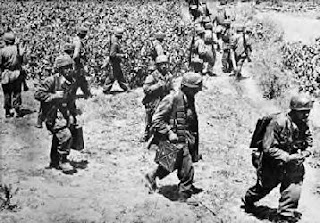 Before the attack on Moscow could begin, operations in Kiev needed to be finished. Half of Army Group Center had swung to the south in the back of the Kiev position, while Army Group South moved to the north from its Dniepr bridgehead. The encirclement of Soviet Forces in Kiev was achieved on July 27th. The encircled Soviets did not give up easily, and a savage battle ensued in which the Soviets were hammered with tanks, artillery and aerial bombardment. In the end, after ten days of vicious fighting, the Germans claimed over 600,000 Soviet soldiers captured but that was false, the German did capture 600,000 males between the ages of 15-70 but only 480,000 were soldiers out of which 180,000 broke out netting the Axis 300,000 Prisoners of war.


 Austrian support for German occupation and future union has been overwhelming: droves of citizens coming out to garland the incoming German troops, waving Nazi flags and wishing them welcome.


